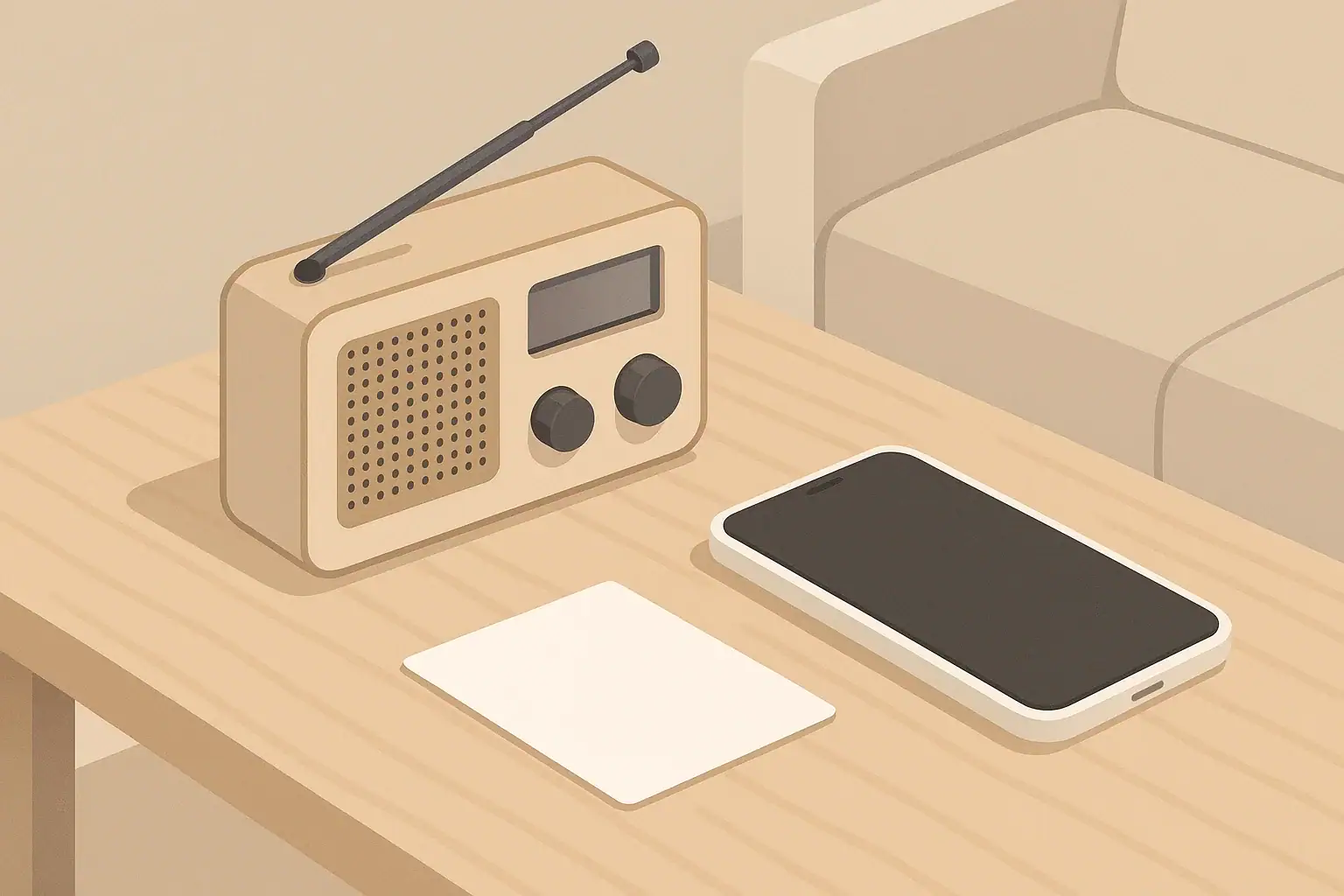
Two-way radios are a simple, low-tech backup for family communication. They can be useful when cell service is overloaded or power is out, especially during short-term disruptions like storms or local outages.
For most households, radios are not about extreme survival scenarios. They are one tool among many for staying in touch when normal conveniences are unreliable. Understanding when they genuinely help, and when they do not, will keep your plans realistic and affordable.
Two-way radios used by families are usually small handheld units that work on shared public frequencies. They are often called “walkie-talkies” and are designed for short-range voice communication.
Why Families Consider Two-Way Radios
Two-way radios are a simple, low-tech backup for family communication. They can be useful when cell service is overloaded or power is out, especially during short-term disruptions like storms or local outages.
For most households, radios are not about extreme survival scenarios. They are one tool among many for staying in touch when normal conveniences are unreliable. Understanding when they genuinely help, and when they do not, will keep your plans realistic and affordable.
Two-way radios used by families are usually small handheld units that work on shared public frequencies. They are often called “walkie-talkies” and are designed for short-range voice communication.
How Two-Way Radios Work in Everyday Family Life
Before you invest time or money, it helps to know the basics of what family radios can and cannot do.
Typical Uses in and Around the Home
In normal, non-emergency life, simple radios can be handy for:
- Around the neighborhood: Checking in while kids play at a nearby park or ride bikes.
- At large venues: Staying in touch at fairs, festivals, or crowded events where cell coverage may be weak.
- During outdoor activities: Hiking, camping, or skiing where cell service is spotty.
- Inside larger homes or properties: Communicating between floors, outbuildings, or yards without shouting.
What “Range” Really Means
Families often see high “miles of range” claims, then feel disappointed. Real-world performance is usually much shorter. Range depends heavily on:
- Obstacles: Buildings, trees, hills, and even dense neighborhoods block or weaken signals.
- Height: Radios held higher (or used on upper floors or hills) work farther than ones at ground level.
- Interference: Other users and electronic noise can make channels noisy.
In a typical residential area, many families find that handheld radios are most reliable within the same property or nearby blocks, not across a whole city.
Battery Reality Check
Two-way radios rely on batteries, which is both a strength and a limitation:
- Pros: They do not need the power grid, they can use rechargeable or disposable batteries, and they often work with small solar or crank chargers as part of a broader kit.
- Cons: Leaving them on all day drains batteries quickly, and dead radios are just paperweights.
For family use, it is usually best to keep radios off most of the time and power them up for scheduled check-ins or specific activities.
Example values for illustration.
| Situation | If this is true… | Then consider… |
|---|---|---|
| Normal daily life | Cell service is working and reliable | Use phones for most communication; keep radios stored but ready |
| Local power outage | Cell service still works but you want to save phone battery | Use radios for quick check-ins at home; use phones sparingly |
| Crowded event or disaster | Texts are delayed or calls are failing | Use radios within your group if you are in the same general area |
| Neighborhood coordination | Several nearby households agree on channels and times | Use radios for brief neighborhood updates during disruptions |
| Long-distance relatives | Your loved ones live across town or in another state | Do not rely on radios; prioritize phone, text, or other network tools |
| Apartment building | Many walls and floors between you and family members | Test radios first; they may only work between nearby floors or units |
When Two-Way Radios Really Help
Two-way radios shine in very specific, practical scenarios. Thinking through these ahead of time helps you use them confidently instead of scrambling during an outage.
Short-Term Power Outages
During a blackout, radios can reduce the need to walk around in the dark just to ask questions like “Are you okay?” or “What is the plan?” Some useful roles:
- Home check-ins: Parents on different floors can coordinate flashlights, meals, or bedtime.
- Yard or building checks: One adult can briefly go outside to look for downed branches or check on a neighbor while staying in touch with the person inside.
- Battery conservation: Using a radio for a quick 10-second update avoids unlocking a smartphone repeatedly.
Coordinating Kids and Teens
For families with kids old enough to follow simple radio rules, these devices can be helpful when:
- Kids are nearby but not in sight: Playing down the block, visiting a neighbor, or riding bikes around the cul-de-sac.
- Teens are helping during a storm: One teen checks the car, another moves patio furniture, and everyone can call for help if needed.
- Phones are put away: Radios can be allowed during certain activities while phones stay off to avoid distraction.
For young children, radios are mostly an adult tool. They may enjoy using them, but an adult should still be physically nearby and in charge of safety decisions.
Outdoor Trips and Remote Areas
On day hikes, camping trips, or ski days, radios can fill gaps where cell signals fade. Helpful uses include:
- Trail coordination: One adult hikes ahead with older kids while another stays behind with a slower group.
- Campground communication: Kids go to the water spigot or restroom with a radio while adults monitor from the campsite.
- Car-to-car coordination: If traveling in multiple vehicles through low-coverage areas, drivers can communicate about stops.
Even then, everyone should still know what to do if they cannot reach each other by radio, such as meeting at a pre-chosen landmark or returning to the last known safe place.
Where Two-Way Radios Fall Short
Two-way radios are not a magical replacement for phones or the internet. Knowing their limitations keeps you from leaning on them for critical tasks they were never meant to handle.
Range and Reliability Limits
Most family radios are meant for short distances. Common limitations include:
- City and apartment blocks: Buildings and metal structures seriously cut range. You may reach someone in the same complex but not across town.
- Dense forests or hills: Trees and terrain make reliable communication harder, especially in valleys.
- Channel crowding: You share frequencies with other users. During busy times, channels may be noisy.
Radios are best viewed as a local tool for your immediate group, not a way to reach emergency services or distant relatives.
Privacy and Security
Family radios are usually unencrypted. Anyone nearby on the same frequency can listen. This means:
- No sensitive info: Avoid sharing full names, addresses, or financial details.
- Simple codes, not secrets: It is fine to agree on basic phrases like “We are okay” or “Meet at home,” but do not expect them to be truly private.
- Kids need clear rules: Explain that other people may hear them, and they should not give out personal details.
Licensing and Etiquette Considerations
Some types of radios require licenses for certain uses. Families often choose options that are license-free for casual, short-range use, but it is still important to:
- Read any quick-start guide or basic instructions that explain permitted use.
- Respect others on the channel, keeping messages brief and polite.
- Avoid pretending to be emergency services or using restricted frequencies.
If you are unsure, keep your usage focused on simple, personal communication over short distances and avoid anything that sounds official.
Building a Simple Family Radio Plan
A little planning goes a long way. The goal is not a complex system, but a few agreed habits that make radios easy and stress-free to use when needed.
Set Clear Purposes
Start by deciding what radios are for in your household. Some examples:
- “At home during outages” plan: Used mainly in blackouts for check-ins between floors or between indoors and outside.
- “Outing and event” plan: Brought to large venues, parks, hikes, and road trips.
- “Neighborhood connection” plan: Coordinated with a couple of nearby trusted households for storm updates.
Writing down these simple use-cases keeps expectations realistic and helps you pack them when they will be genuinely useful.
Agree on Channels and Call Signs
To avoid confusion, decide together:
- Primary channel: The main channel your family uses for normal communication.
- Backup channel: A second choice if the first is crowded.
- Plain-language “call signs”: Simple names like “Mom,” “Grandpa,” or “Apartment 2A,” rather than complicated codes.
Write this information on a small, text-free card that stays with the radios so no one has to remember it under stress.
Simple Check-In Schedules
In many short-term disruptions, you do not need a constant open channel. A basic schedule is often enough, for example:
- During an outage, check in every hour on the hour.
- On a hike, quick status updates at major trail junctions.
- At large events, check in at agreed times or before moving to a new area.
This reduces battery drain and helps everyone know when to listen.
Battery Management and Backup Power
Radios are only helpful if they power on. A small amount of planning keeps them ready for months at a time.
Choose a Battery Strategy
Most household radios use one of three approaches:
- Built-in rechargeable battery: Convenient but depends on charging options.
- Replaceable standard batteries: Flexible; you can store extras and swap them during outages.
- Mixed approach: A rechargeable battery pack plus an option to use standard batteries.
Whatever you choose, match it to your broader home readiness plan, including flashlights, small lanterns, and any backup power banks you keep.
Storing and Rotating Batteries
Basic habits help batteries last and work when needed:
- Store batteries in a cool, dry place, away from extreme heat.
- Keep different battery types organized to avoid mixing old and new.
- Mark a simple reminder on your calendar to test and rotate batteries a few times a year.
When you test radios during these checkups, also confirm that all family members remember how to turn them on, change channels, and adjust volume.
Example values for illustration.
| Who to contact | Primary method | Fallback | Meeting point note |
|---|---|---|---|
| Household adults | Cell call or text | Two-way radios at home | If no contact, meet in kitchen or living room |
| Kids at nearby park | Two-way radios | Adult walks to park | If radios fail, kids return directly home |
| Neighbor next door | Knock on door | Two-way radios if agreed in advance | If not home, leave a written note |
| Relative across town | Text message | Brief phone call | If no contact, they stay put; you stay put |
| Out-of-area contact | Text or call when networks allow | Email or messaging app later | No physical meeting; they serve as information relay |
| Family during road trip | Cell phones between vehicles | Two-way radios between cars | If separated, meet at next planned stop |
Fitting Radios into Your Overall Readiness Plan
Two-way radios work best as part of a simple, layered approach to communication, not as the only tool you rely on.
For a typical household, a balanced plan might include:
- Charged phones with key numbers saved and written down on paper.
- A small battery or solar charger for phones and radios.
- Two-way radios stored with fresh batteries in a known spot, alongside flashlights.
- Clear meeting places and check-in rules if communication fails entirely.
By viewing two-way radios as one helpful, but limited, piece of your home readiness toolkit, you can use them confidently during blackouts, outings, and local disruptions—without expecting them to solve every problem.
Authoritative sources
Safety recommendations can change. Confirm critical details with current official guidance and local authorities.
- USDA FSIS: Keep Food Safe During Emergencies
- U.S. CPSC: Battery Safety
- CDC: Guidelines for Cleaning Safely After a Disaster
Frequently asked questions
How far do typical family two-way radios reach in a neighborhood?
Range varies widely: in built-up residential areas handheld consumer radios often work best within the same property or nearby blocks, while in open, line-of-sight conditions they can reach a few miles. Obstacles like buildings, trees, and hills can reduce range dramatically, so test radios where you will use them.
Do I need a license to use two-way radios for family use?
That depends on the radio type and your country’s rules. Some short-range radios are license-free and intended for casual family use, while other bands or higher-power radios may require registration or a license; check local regulations before using radios outside the manufacturer’s specified, license-free modes.
What’s a practical battery strategy for family radios?
Keep radios off unless in use, store spare batteries in a cool, dry place, and test and rotate batteries a few times a year. Consider a mixed approach (rechargeable plus the option for standard disposable batteries) and include a small charger or power bank in your readiness kit.
Can two-way radios replace cell phones during emergencies?
No; two-way radios are a local, short-range tool and are not a complete replacement for phones or internet-based communication. Use them as one layer in a broader plan that includes charged phones, written contact information, and agreed meeting places.
How can families protect privacy when using shared radio channels?
Assume transmissions can be heard by others on the same frequency and avoid sharing sensitive personal or financial details. Agree on simple phrases or codes for common statuses, choose primary and backup channels, and instruct children not to give out personal information over the radio.
- Simple checklists and realistic planning
- Water, power, lighting, and pantry basics
- Family plans (kids, pets, seniors) and seasonal prep
Affiliate disclosure
As an Amazon Associate, we earn from qualifying purchases. Some links on this site may be affiliate links. If you buy through these links, we may earn a small commission at no extra cost to you. This helps support our content. Learn more.