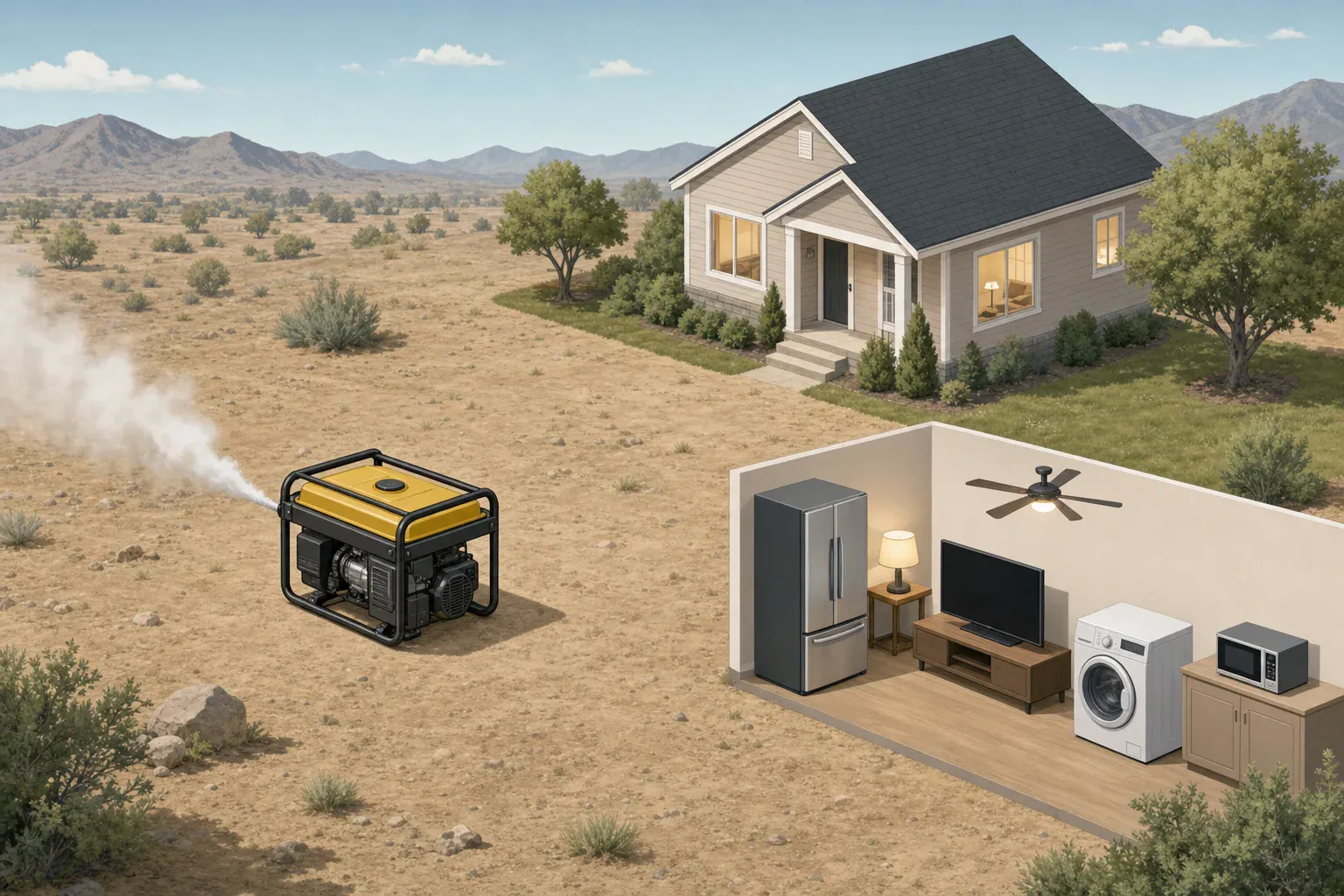
To size a portable generator, add the running watts of the essential loads you expect to use at the same time, then account for the largest motor-starting demand. Choose a generator whose continuous rated output exceeds the running total and whose surge output exceeds the calculated startup demand.
Do not select a generator by its advertised peak wattage alone. Confirm voltage, outlet, circuit, fuel, and connection requirements as well. Appliance labels and manuals take priority over generic wattage charts.
List only the loads you truly need
Begin with a short list of essentials rather than everything in the house. Depending on your household and the season, that could include:
- A refrigerator or freezer
- A furnace blower or small room heating system approved for generator use
- A well, sump, or septic pump
- A few lights
- Phones, radios, and internet equipment
- Necessary medical or accessibility equipment
Record which loads must run continuously and which can run in turns. Load management can reduce the generator size needed, but appliances such as refrigerators and pumps may start automatically. If you plan to alternate them, you need a practical way to prevent overlapping starts.
For life-sustaining medical equipment, confirm backup-power requirements with the equipment supplier, clinician, or manufacturer. A portable generator should not be treated as the only backup for critical care.
Find each load’s running and starting watts
Check the appliance data plate, manual, or manufacturer documentation. Look for these values:
- Running watts: Power used during normal operation.
- Starting watts: Brief extra power needed when a compressor, pump, or motor starts.
- Voltage: Usually 120 volts or 240 volts for household equipment.
Use the equipment’s input watts, not its heating output, cooling capacity, or other performance rating. If a label lists only volts and amps, multiplying them gives volt-amperes. That is not always identical to watts for motors and electronic loads, so consult the manual or manufacturer rather than treating the result as an exact wattage.
Hardwired equipment can be difficult to identify correctly. An electrician or HVAC technician can determine the operating and starting requirements for a furnace blower, heat pump, central air conditioner, well pump, or similar load.
Calculate the required output
- Add the running watts of everything that may operate at once.
- Identify the load with the highest starting wattage.
- Add that load’s full starting wattage to the running watts of all the other loads.
- Compare both results with the generator’s continuous and surge ratings.
This method assumes only one major motor starts at a time. If two motors could start together, calculate that possible combination or arrange the loads so it cannot happen.
The following numbers are an invented math example, not estimates for real appliances:
| Example load | Running watts | Starting watts |
|---|---|---|
| Refrigerator | 700 | 2,200 |
| Furnace blower | 600 | 1,200 |
| Lights | 100 | 100 |
| Internet equipment | 20 | 20 |
| Phone charging | 20 | 20 |
The running total is 1,440 watts. The largest startup case is the refrigerator starting while the other loads use 740 running watts: 2,200 + 740 = 2,940 watts. For these sample values, the generator would need continuous output above 1,440 watts and surge output above 2,940 watts.
Avoid planning to operate continuously at the generator’s exact limit. Output capability and operating restrictions may vary with the model, temperature, elevation, fuel, and maintenance condition. Follow the generator manual.
Check voltage and connection requirements
Total wattage is not enough by itself. Verify that the generator provides the required voltage and that each outlet or circuit can carry its assigned load. A generator may have enough total wattage but still be unable to supply a particular 240-volt load or a high-amperage 120-volt load.
Plug-in appliances may be connected only as the generator manufacturer permits, using outdoor-rated cords sized for the load and kept in good condition. Hardwired equipment requires properly installed transfer equipment. Never connect a generator to a household receptacle or otherwise backfeed home wiring.
A qualified electrician should select and install a transfer switch or other listed transfer equipment. Grounding and neutral-bonding requirements depend on the generator, transfer arrangement, and local electrical rules. Follow the generator instructions, local codes, and the electrician’s directions rather than applying a universal setup.
Use load management when practical
You may be able to use a smaller generator by scheduling high-demand loads. For example, you might cool a refrigerator before turning on a pump or other motor load. Keep smaller essentials running only if their combined demand remains within every applicable rating.
Load management does not make an undersized generator safe. If lights flicker severely, breakers trip, the engine repeatedly bogs down, or connected equipment does not operate normally, disconnect loads and consult the manuals or a qualified professional.
Operate the generator safely
Generator exhaust contains carbon monoxide, an odorless gas that can kill. Follow Ready.gov power outage and generator guidance: operate a portable generator outdoors at least 20 feet from the home, with exhaust directed away from windows, doors, and vents. Never use one inside a home, basement, shed, crawlspace, or garage, even with doors open.
- Use working carbon monoxide alarms with battery backup as recommended for your home.
- Keep the generator dry and follow its manual for weather protection; do not improvise an enclosure that can trap exhaust or heat.
- Let the generator cool before refueling, and store fuel only in approved containers as directed by local fire rules and the manufacturer.
- Do not overload the generator, its outlets, extension cords, transfer equipment, or individual circuits.
- Follow local restrictions and all manufacturer instructions. A qualified electrician should take priority for questions about home wiring or hardwired loads.
- Simple checklists and realistic planning
- Water, power, lighting, and pantry basics
- Family plans (kids, pets, seniors) and seasonal prep
Affiliate disclosure
As an Amazon Associate, we earn from qualifying purchases. Some links on this site may be affiliate links. If you buy through these links, we may earn a small commission at no extra cost to you. This helps support our content. Learn more.