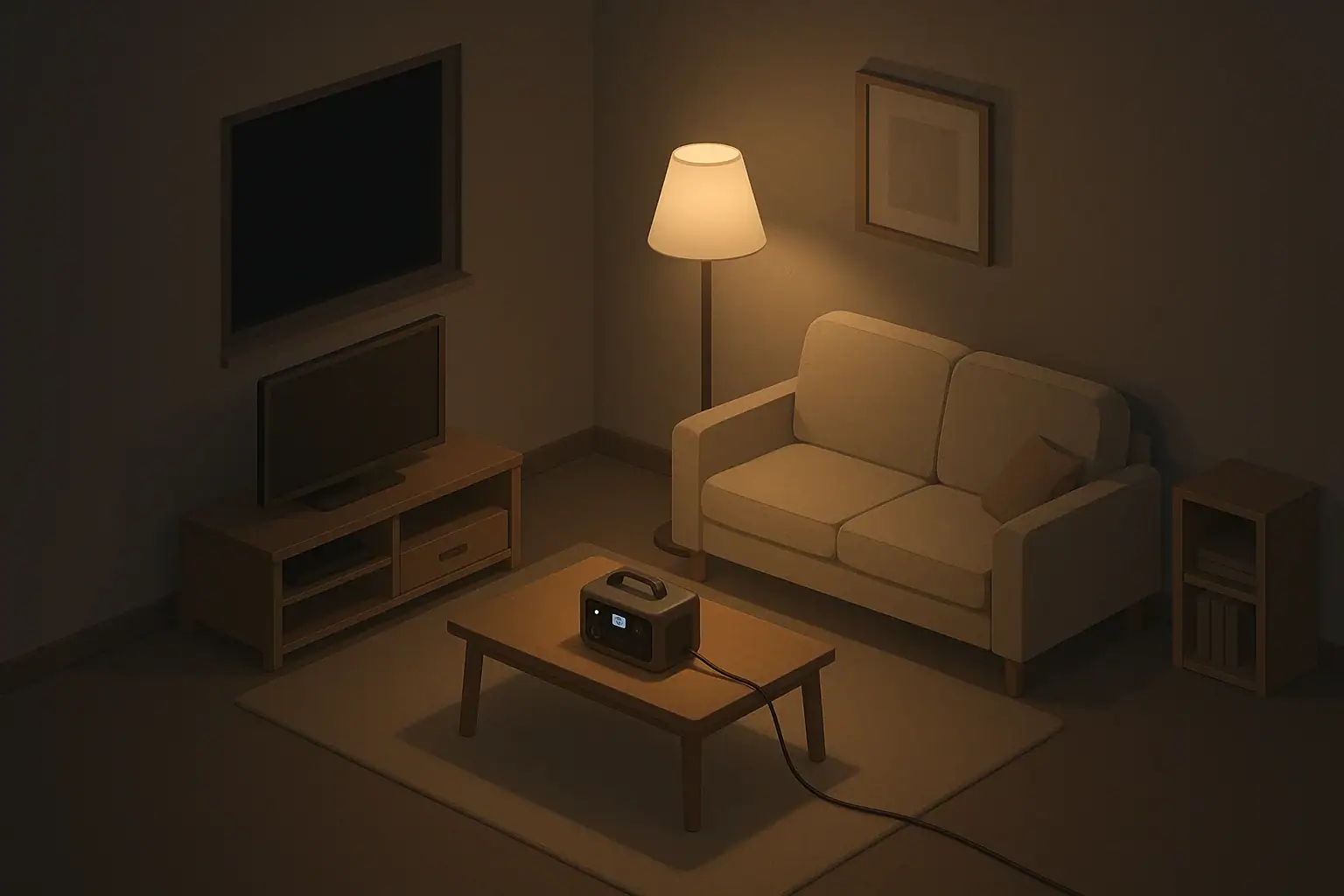
Why High-Wattage Appliances Are Tricky on Backup Power
Microwaves, electric kettles, and space heaters are some of the hungriest devices in a home. They turn electricity directly into heat, which takes a lot of power in a short time. That is the opposite of what most small backup systems do best.
Common backup options for homes and apartments include:
- Small battery power stations
- Car inverters (plugged into a vehicle)
- Portable generators
- Whole-home standby generators
Each of these has limits on how many watts it can supply at once and how many watt-hours it can store. High-wattage appliances can hit those limits very quickly.
For perspective, many everyday items use far less power than heat-making appliances. Examples (approximate ranges only):
- LED lamp: tens of watts
- Phone or tablet charger: under 50 watts
- Laptop: roughly 50–100 watts
- Wi‑Fi router: tens of watts
In contrast, kitchen and heating appliances often draw hundreds to over a thousand watts, sometimes more. That matters for both can it run at all? and how long before the backup is drained?
Understanding Watts, Surges, and Runtime
To decide what you can reasonably power, it helps to break the problem into two simple questions:
- Power (watts): Can the backup source handle the appliance’s peak draw without tripping or shutting down?
- Energy (watt-hours): If it can, how long until the battery or fuel runs out?
Backup options usually list these numbers:
- Continuous watts: The maximum power they can provide steadily.
- Surge watts: A short burst they can handle for start-up spikes.
- Capacity (for batteries): Watt-hours, which roughly equals watts × hours.
Example, for illustration only: If a battery has a 500 watt-hour capacity and you try to run a 1000 watt appliance, two issues appear:
- If the inverter is only rated to 500 watts, it may shut down immediately.
- Even if it could somehow run, it would drain in well under an hour at that load.
Realistic home outage planning often means choosing low-wattage devices that stretch your limited backup capacity for essentials such as communication, minimal lighting, and keeping food safe.
Example values for illustration.
| Appliance type | Typical power draw idea | Backup power that is usually realistic | Notes |
|---|---|---|---|
| Small LED lamp, phone charger | Low tens of watts | Most battery packs and car inverters | Good first priorities for outages. |
| Wi‑Fi router, laptop | Dozens to about 100 watts | Modest power stations or car inverter | Often practical for several hours. |
| Small microwave on low power | Several hundred to about 1000 watts | Mid-size power station or portable generator | Short runs only; watch total load. |
| Electric kettle | Often around 1000 watts or more | Mid/large power station or generator | Brief use; may quickly drain batteries. |
| Portable space heater | Often 1000–1500 watts | Portable or whole-home generator | Usually not practical on small batteries. |
| Central AC or electric range | Very high draw | Whole-home standby generator | Beyond most small backup setups. |
Microwaves on Backup Power: What’s Realistic?
Microwaves are power-hungry, but they usually run only for a few minutes. That makes them more feasible than something that must run for hours, but only if your backup can handle the surge and wattage.
What to check before using a microwave
- Wattage label: Look for input watts on the back or inside the door. This is often higher than the “cooking watts” in the manual.
- Backup rating: Compare the microwave’s input watts to the continuous rating of your battery, inverter, or generator.
- Surge handling: Microwaves can draw more when they start. Your backup should have some headroom above the rated watts.
- Other loads: Avoid running other heavy loads at the same time on the same backup source.
Battery power stations and microwaves
Many small battery stations are designed for phones, laptops, and lights, not microwaves. Possible limitations include:
- Inverter too small for the microwave’s wattage.
- Battery capacity too small for more than a few minutes of use.
- Thermal or overcurrent shutoff if pushed too hard.
If you do use a microwave from a battery system:
- Heat food in short bursts and let the system rest between runs.
- Monitor for unusual smells, heat, or error lights.
- Reserve most of the battery for essentials like refrigeration bridging, phones, or medical-related devices if needed (planning done with a professional when appropriate).
Car inverters and microwaves
A car inverter converts your vehicle’s 12 V system to household-style outlets. Microwaves push these systems hard. Concerns include:
- Overloading the inverter or blowing fuses.
- Straining the vehicle’s alternator or draining the battery if the engine is off.
- Running a vehicle in an enclosed space, which is unsafe due to exhaust.
If you try this, follow inverter sizing guidance from a qualified source, keep the vehicle outdoors with exhaust pointed away from the home, and limit use to very short sessions.
Generators and microwaves
Portable and standby generators usually handle microwaves more comfortably, as long as the unit is sized correctly. Basic tips:
- Start the generator and let it stabilize before turning on the microwave.
- Run the microwave alone or with only light additional loads.
- Follow fuel storage and ventilation safety guidance; generators stay outside, away from windows and doors.
Electric Kettles on Backup Power: Fast but Power-Hungry
Electric kettles pull a lot of power, but usually for only a few minutes at a time. That makes them similar to microwaves in planning terms: high watts, short runtime.
How kettles behave on backups
A typical electric kettle can boil a liter of water in several minutes. On a small battery or inverter, those few minutes may:
- Use a large portion of available capacity.
- Trip an overcurrent safety if the wattage is above the system rating.
- Cause voltage drops that can shut down the backup system.
Alternatives for heating water during outages
If your backup system is modest in size, consider other ways to produce hot water that do not rely on a high-wattage kettle:
- Gas stove with ignition: Many gas cooktops can be lit with a match if electronic ignition is out. Follow manufacturer guidance and safety instructions.
- Portable camp stove (outdoors only): Use only where ventilation is adequate and open flames are safe and allowed.
- Insulated thermos: When power is on, pre-heat and store hot water for later.
- No-heat options: For drinks and food that accept it, room-temperature water avoids the issue entirely.
When an electric kettle might still make sense
An electric kettle may be reasonable on backup power if:
- Your battery or generator is comfortably rated above the kettle’s wattage.
- You only need to boil small amounts of water occasionally.
- You are willing to sacrifice some runtime for other uses to have hot water.
Even then, it is usually wise to prioritize lower-power needs first, then decide if a few minutes of hot water is worth the tradeoff.
Space Heaters on Backup Power: Usually a Bad Match
Portable electric space heaters are among the toughest appliances to run on backup power. They often draw near the limit of a typical household circuit and need to run for long periods to be useful.
Why electric heat is hard to back up
- Very high wattage: Many units operate around 1000–1500 watts.
- Long runtimes: To keep a room comfortable in cold weather, they may need to run much of the time.
- Battery drain: Even relatively large battery stations can be depleted quickly by continuous electric heat.
- Multiple circuits: Heating an entire home this way is beyond what most portable backups can do.
When can you run a space heater?
Using an electric space heater on backup power might be plausible if:
- You have a generator sized for whole-home or large loads.
- You heat a single small room and accept frequent fuel refills.
- You only need short bursts of heat (for example, taking the edge off a cold room before bed).
Even then, fuel supply, noise, and safety (especially around kids and pets) should be part of your planning.
Safer and more efficient cold-weather strategies
Instead of relying on electric space heaters, consider a layered approach for short-term winter outages:
- Room consolidation: Have everyone sleep in one or two rooms you can close off.
- Insulation steps: Close curtains, hang blankets over drafty doors, and roll towels against gaps.
- Clothing and bedding: Use layered clothing, socks, hats, and extra blankets or sleeping bags.
- Timing with central heat: If you have a fuel-burning furnace that only needs electricity for controls and fans, a properly sized generator can sometimes keep the main heat system running; consult a qualified technician for safe connection options.
Backup power is often better used for running the main heating system’s low-power components (if that is feasible and safely wired) rather than trying to generate significant heat through portable electric heaters.
Planning for Apartments vs Houses
Where you live shapes what backup power options make sense for you and which appliances you can realistically run.
Apartment and condo considerations
Many multi-unit buildings have rules and physical limits that affect backup power decisions:
- No generators on balconies: Noise, exhaust, and safety risks often make this prohibited.
- Limited storage: Less space for fuel, large batteries, or bulky equipment.
- Shared infrastructure: Building-wide systems like central boilers or elevators are outside your control.
In smaller spaces, it often makes sense to focus backup plans on:
- Low-wattage lighting and communication devices.
- A small power bank or station for phones and a few small appliances.
- Nonperishable food that does not require cooking.
- Warm clothing and compact bedding for cold conditions.
Detached houses and townhomes
Homes with more space and outdoor areas have more options:
- Portable generators placed safely outside.
- Larger battery systems, sometimes combined with rooftop solar.
- More room for fuel, water, and food storage.
Houses also introduce other loads, such as:
- Well pumps.
- Sump pumps.
- Furnace blowers or boiler circulation pumps.
These can be more important to keep running than a microwave or kettle, especially in storms or extreme temperatures. A basic load list, written down ahead of time, helps you decide what gets priority.
Simple Outage Scenarios: What to Power First
Thinking through a few likely scenarios can clarify whether running a microwave, kettle, or space heater is worth the backup capacity.
Short summer outage (heatwave, a few hours)
- Priority loads: Fans, phone charging, possibly a small fridge or freezer, basic lighting.
- Microwave: Possibly useful for a quick meal if capacity allows.
- Kettle: Usually optional; cold drinks are often fine.
- Space heater: Not relevant.
Overnight winter outage (cold snap)
- Priority loads: Maintained home heat if possible, carbon monoxide and smoke detectors, communication devices.
- Microwave: Helpful for quick warm food if power margin exists.
- Kettle: Nice to have but lower priority than keeping rooms warm.
- Space heater: Usually impractical on small systems; focus on insulation and clothing layers instead.
Multi-day storm (hurricane or winter storm)
- Priority loads: Refrigeration, small circulation pumps, charging, minimal lighting, weather updates.
- Microwave: Can be useful but may compete with fridge/pump needs on smaller generators.
- Kettle: Occasional use is feasible with fuel or large battery capacity.
- Space heater: More realistic only with a properly sized generator and careful fuel planning.
Example values for illustration.
| Device type | Typical watts range idea | Runtime on a 500 Wh battery (rough estimate) | Planning notes |
|---|---|---|---|
| LED lamp | 10–15 watts | 20–30 hours | Efficient for evening use in blackouts. |
| Wi‑Fi router | 10–20 watts | 12–30 hours | Helps with updates if internet stays up. |
| Laptop | 50–70 watts | 6–10 hours | Stagger use and rely on internal battery. |
| Small fridge (average) | 50–150 watts (cycling) | Several hours to part of a day | Keep door closed to extend time. |
| Microwave in short bursts | 700–1000 watts | Well under 1 hour total cook time | Use sparingly for reheating only. |
| Portable space heater | 1000–1500 watts | Less than 30 minutes | Generally not practical on small batteries. |
Practical Takeaways for Everyday Households
For most homes and apartments, backup power is best treated as a way to stay informed, see clearly, preserve food, and keep a few small comforts, not to fully replace normal grid power.
When it comes to microwaves, kettles, and space heaters:
- Microwaves: Often usable for brief cooking on a generator or robust power station; check wattage carefully.
- Kettles: High draw for a short time; consider alternatives if your backup is small.
- Space heaters: Rarely a good fit for small battery setups; prioritize building warmth through insulation and clothing.
A simple written plan that lists your priority devices, approximate wattages, and backup capacity can turn a stressful outage into an inconvenience you are prepared to manage calmly.
Related guides: Backup Power Costs Explained: One-Time Gear vs Ongoing Fuel and Batteries · Room-by-Room Emergency Kit Audit: What to Check in 20 Minutes.
Authoritative sources
Safety recommendations can change. Confirm critical details with current official guidance and local authorities.
- CDC: Carbon Monoxide Poisoning Basics
- USDA FSIS: Keep Food Safe During Emergencies
- U.S. CPSC: Battery Safety
Frequently asked questions
Can a small battery power station run a 1000 W microwave for reheating?
Possibly, but only if the station’s inverter supports at least the microwave’s continuous input watts and its capacity is sufficient for the short run. A 500 Wh battery, for example, would be exhausted quickly by a 1000 W draw and many small inverters cannot sustain 1000 W continuous. Always compare both the inverter’s continuous and surge ratings and plan for only brief use.
How many kettle boils can I get from a 1000 Wh power station?
Electric kettles typically draw 1000–1500 W and boil a liter in a few minutes. A 1000 Wh station could theoretically deliver roughly 40–60 minutes at that power level in ideal conditions, but inverter limits, inefficiencies, and safety cutouts usually reduce usable time—practically you may get several short boils rather than continuous use. Check your station’s continuous rating before attempting multiple boils.
Is it safe to use a car inverter to power a microwave or kettle?
It’s generally not recommended unless the inverter and vehicle electrical system are rated for the appliance’s continuous and surge demand. High-draw appliances can overload the inverter, strain the alternator, or drain the battery quickly; if attempted, run the vehicle outdoors with ventilation, use a properly sized inverter, and limit use to short bursts. Follow manufacturer and safety guidance to avoid fire or carbon monoxide risks.
Can I run a 1500 W space heater on a portable generator for hours?
Yes, if the generator is sized to handle the heater plus any other loads and you have sufficient fuel, but fuel consumption and noise make this a tradeoff. Continuous electric heat is fuel-intensive and may be impractical for long outages on smaller generators; a whole-home standby generator or alternative heating strategies are often better choices. Prioritize safe placement and fire-safety practices whenever using space heaters.
What are low-power alternatives for hot water and warmth during an outage?
Consider a gas cooktop (lit manually if needed), an outdoor camp stove with proper ventilation, pre-heating and storing hot water in an insulated thermos, and non-electric approaches like layering clothing, consolidating people into one room, and using sleeping bags. When available, using a generator to run the home’s low-power heating controls (installed safely by a professional) can also be more efficient than relying on portable electric heaters.
- Simple checklists and realistic planning
- Water, power, lighting, and pantry basics
- Family plans (kids, pets, seniors) and seasonal prep
Affiliate disclosure
As an Amazon Associate, we earn from qualifying purchases. Some links on this site may be affiliate links. If you buy through these links, we may earn a small commission at no extra cost to you. This helps support our content. Learn more.