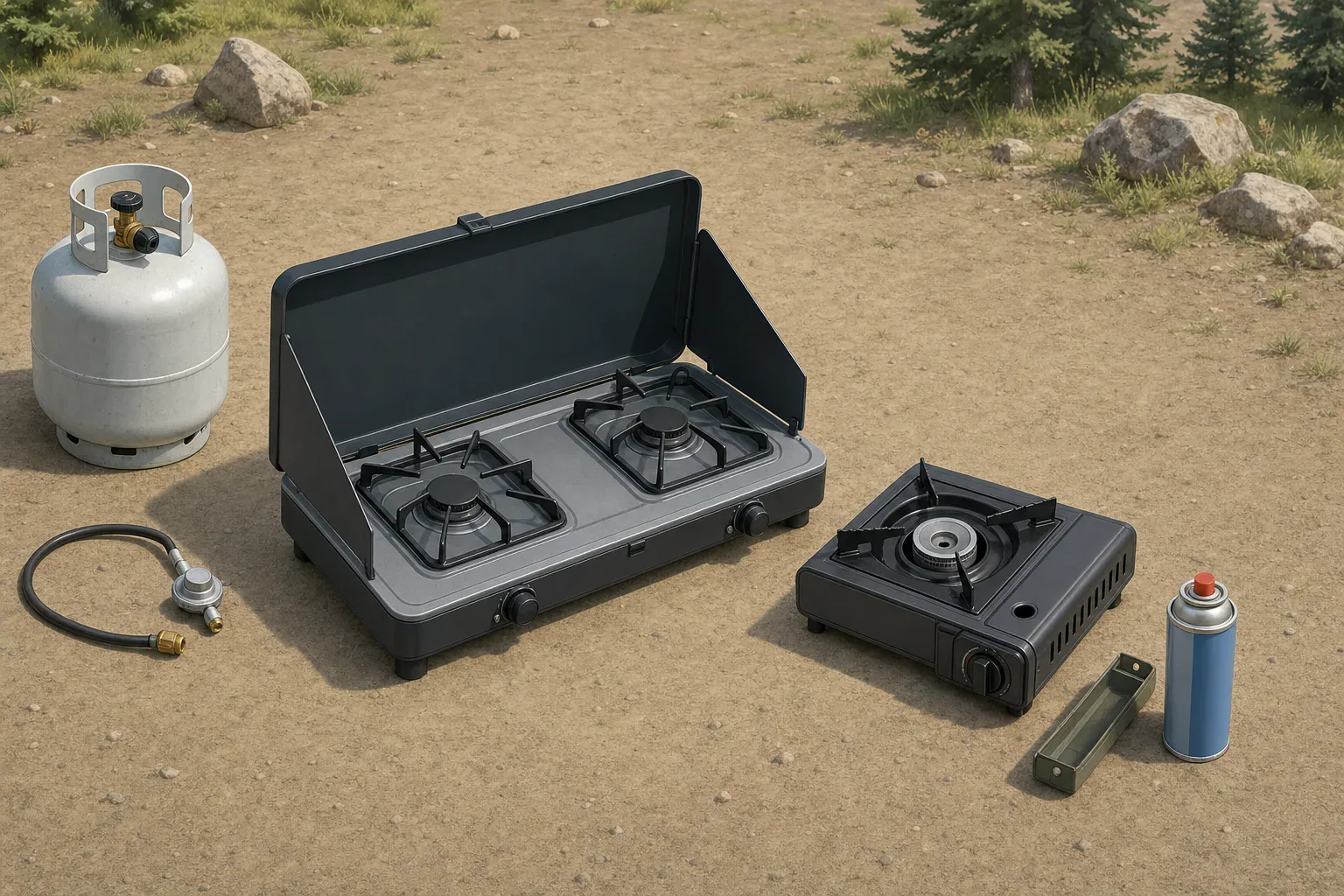
Quick answer: For most households able to cook outdoors, a propane stove is the more adaptable emergency option for freezing-weather outages or meals needing two burners. A butane cassette stove can fit mild weather, limited storage, and one-pan cooking. Neither fuel makes a portable camp stove generally safe to use indoors.
Start with the outdoor-use safety boundary
Propane and butane stoves are combustion appliances. Fuel type alone does not make a portable stove safe for indoor household use.
FEMA power-outage guidance says to operate camp stoves outdoors, at least 20 feet from windows, doors, garages, and other building openings. The CDC’s winter-storm safety guidance also says never to use camp stoves inside a home, basement, or garage, or near a window.
An open window or open garage door does not turn an indoor location into a safe outdoor cooking area. Follow the exact stove manual, local fire restrictions, and instructions from emergency officials. If any instruction conflicts, use the more restrictive rule.
Propane vs butane emergency stove: key differences
| Decision factor | Propane stove | Butane cassette stove |
|---|---|---|
| Emergency location | Plan to use it outdoors under federal emergency guidance and the appliance manual. | Plan to use it outdoors under federal emergency guidance unless the exact appliance and setting meet stricter manual conditions. |
| Freezing weather | Often the more adaptable starting point to investigate, but operating limits depend on the stove, regulator, and container. | May have important cold-weather limits. One reviewed model prohibits use below 32°F. |
| Cooking setup | Can be a practical fit when an approved two-burner model matches the household’s cookware and meal plan. | Compact cassette models can fit one-pan cooking and smaller preparedness kits. |
| Fuel runtime | Depends on the exact stove, cylinder, burner settings, weather, and cooking task. | Depends on the exact stove, canister, burner setting, temperature, and cooking task. |
| Best planning fit | Cold-season preparation, larger meals, or households wanting two burners. | Mild-weather preparation, limited space, or simple one-pan meals. |
These are planning distinctions, not universal performance guarantees. A stove’s design matters as much as its fuel.
How to choose between propane and butane
Consider the lowest likely temperature
Butane appliances can have explicit cold-weather restrictions. For example, the manufacturer’s manual for one portable butane stove says that model is not for use below 32°F. That limit applies to the named model, not every butane stove.
If winter outages are plausible, propane is the more practical default to investigate. Do not assume a universal minimum propane temperature, however. Confirm the operating limits in the manual for the complete setup you intend to use.
Match the stove to actual meals
List two or three outage meals before selecting a stove. Record the cookware diameter, number of pots needed at once, simmering needs, and whether you must heat water while preparing food. A two-burner layout may matter more than a headline output rating.
Check the manual’s cookware limits and required clearances. Oversized pans can trap heat around a cassette compartment or other stove components. Use only wind protection permitted by the manufacturer; do not surround the stove with an improvised enclosure.
Check the complete fuel connection
Write down the exact stove model and every approved fuel-container type. Do not assume an aftermarket hose or adapter makes a small-cylinder stove suitable for a larger tank. Use only containers, regulators, hoses, and adapters explicitly approved for that appliance and configuration.
Evaluate storage as a complete plan
A cassette stove may occupy little room, but compare the total space required for the stove and the amount of fuel you plan to keep. Review the appliance and fuel-container instructions, local fire rules, and any restrictions that apply to your home. Do not buy more fuel than you can store and inspect correctly.
Why published runtime is not a household fuel plan
Runtime figures apply to a specific stove, fuel container, burner setting, and test condition. They do not establish how many meals every propane or butane container will provide. High heat, multiple burners, wind, low temperatures, and longer recipes can all change fuel use.
Create a household-specific estimate with an outdoor practice session:
- Choose one normal outage meal and the cookware you would actually use.
- Set up the stove outdoors exactly as its manual directs.
- Inspect and connect the fuel using the manual’s procedure.
- Time the burner use required to prepare the meal, including water heating.
- Record the burner settings and outdoor conditions.
- Repeat with another representative meal if your cooking needs vary.
- Use those observations, along with the manufacturer’s model-specific runtime information, to decide how much approved fuel to keep.
Do not treat one practice result as a guarantee. Keep a reasonable margin for colder, windier, or longer-than-expected outages without exceeding safe storage limits.
Does dual fuel mean safer?
No. A dual-fuel label describes flexibility, not automatic safety. Each fuel configuration still has its own approved container, connection procedure, operating limits, and location requirements.
A dual-fuel stove may be useful when you want more than one approved fuel option. It does not make indoor operation acceptable, prevent carbon monoxide, or make unapproved adapters safe. Read the instructions for both configurations before relying on the stove.
Pre-outage stove checklist
- Record the stove’s exact manufacturer and model number.
- Save a paper copy of its manual with the stove.
- Identify the approved fuel and container sizes.
- Confirm the manual-designated operating location.
- Compare its temperature limits with local winter conditions.
- Check burner count, cookware limits, and required clearances.
- Practice the connection and leak-check procedure specified in the manual.
- Measure fuel use for representative meals during outdoor practice.
- Check for recalls before placing the stove in service.
- Keep an ignition method permitted by the manual.
- Maintain working carbon monoxide alarms in the home as directed by their manufacturer.
- Reinspect the stove and fuel containers before each use.
Frequently asked questions
Can a propane or butane emergency stove be used indoors?
Do not treat either fuel type as generally safe for indoor camp-stove use. FEMA advises using camp stoves outdoors and away from building openings, while CDC says not to use camp stoves inside a home, basement, or garage. Follow the appliance manual and any local emergency directions.
Will a butane stove work below freezing?
It depends on the model. The cited Iwatani 35FW portable butane stove manual says that model is not for use below 32°F (0°C). Do not apply that exact limit to every butane stove; check the manual for the model and fuel canister you own.
How much fuel should I keep for emergency cooking?
There is no universal meal-per-cylinder number. Choose representative meals, practice outdoors using the exact stove and cookware, record burner time and conditions, then compare those observations with the manufacturer’s model-specific fuel information and applicable storage rules.
For many households, the practical choice is an approved propane setup for outdoor winter or multi-burner cooking, or a butane cassette stove for compact, mild-weather, one-pan use. The safest final decision comes from matching an exact appliance manual to your location, climate, cookware, and storage situation.
- Simple checklists and realistic planning
- Water, power, lighting, and pantry basics
- Family plans (kids, pets, seniors) and seasonal prep
Affiliate disclosure
As an Amazon Associate, we earn from qualifying purchases. Some links on this site may be affiliate links. If you buy through these links, we may earn a small commission at no extra cost to you. This helps support our content. Learn more.