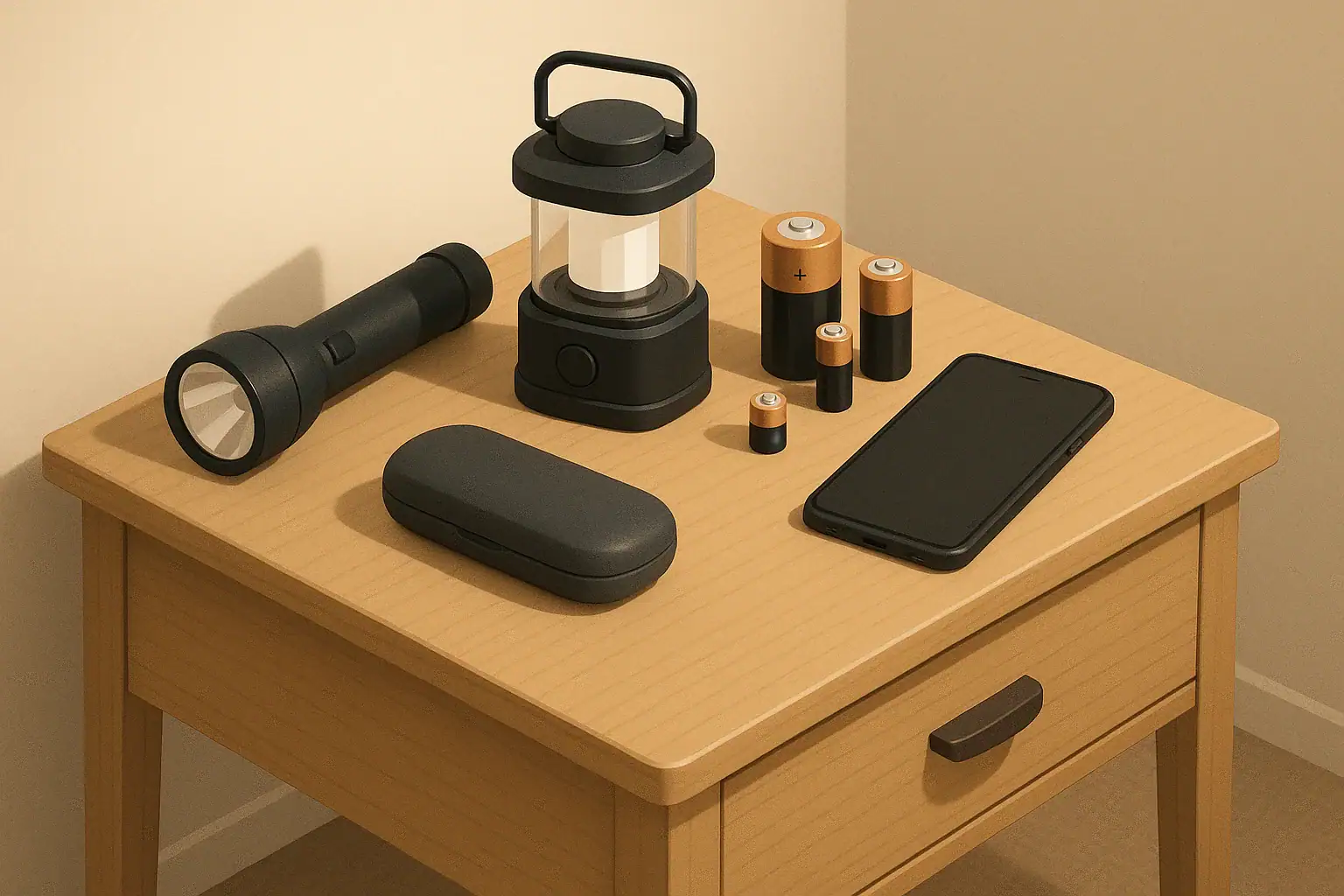
A power outage in the middle of the night can be disorienting. Reaching for a bright overhead flashlight across the room, stumbling to find glasses, or searching for medication in the dark all increase the risk of falls and confusion. A simple nightstand blackout kit keeps the most important items within arm’s reach so you can safely orient yourself, check on family members, and decide what to do next.
This kind of mini-kit is especially useful in small apartments, multi-story homes, and for households with kids, pets, or older adults. It supports calm, practical readiness for brief outages from storms, grid issues, or maintenance work—without turning your bedroom into a storage closet.
Before adding gear, think about how you actually move around at night. The right setup looks different for a studio apartment than for a large house, and different again for someone caring for young children or an older family member.
Why a Nightstand Blackout Kit Matters
Planning Your Nightstand Setup
Before adding gear, think about how you actually move around at night. The right setup looks different for a studio apartment than for a large house, and different again for someone caring for young children or an older family member.
Think Through Your Nighttime Routine
Consider these questions as you plan:
- What do you usually reach for first? Glasses, water, phone, or medications.
- Who might need your help? Kids down the hall, a roommate, or a partner.
- How far is the bathroom? Safer lighting may matter more if you need to move through a hallway or stairs.
- Do you use mobility aids? Canes, walkers, or braces should be positioned so you can reach them in the dark.
Nightstand vs. Bedside Caddy vs. Wall Hook
If you do not have a large nightstand, you can still keep a small blackout kit close:
- Small nightstand: Prioritize flat items (phone, glasses, pill case) and one compact light.
- Bedside caddy: A fabric organizer that hangs from the bed frame can hold a flashlight, phone, and small notebook.
- Wall hook or shelf: Place a flashlight or lantern where you can touch it without standing up.
Whichever option you choose, practice reaching for items with your eyes closed to confirm the layout feels natural and safe.
Example values for illustration.
| Task | Why it matters | Notes |
|---|---|---|
| Choose a reachable spot for your main light | Prevents fumbling and possible falls in the dark | Test with eyes closed from your usual sleep position |
| Assign a fixed place for glasses | Makes rapid orientation easier when power fails | Use a simple tray or case to create a clear “home” |
| Prepare a small container for nightly medications | Reduces the chance of dropping or misplacing pills | Label containers clearly and keep original bottles nearby |
| Set up an easy phone charging spot | Keeps your phone ready for calls and alerts | A short cable and simple outlet location help avoid tangles |
| Place a backup battery within reach | Provides extra runtime during longer outages | Pick a size that fits your nightstand or caddy |
| Do a quick dark-room drill | Confirms the layout works when you cannot see | Try once every few months or after rearranging furniture |
Safe Lighting for Nighttime Power Outages
The most important part of a nightstand blackout kit is safe, simple lighting you can turn on without thinking. The goal is not to light your entire home—just to see well enough to move safely, check on others, and decide your next steps.
Types of Lights That Work Well at the Bedside
Most households already own at least one small light. The key is to dedicate one for your nightstand and keep it there. Common options include:
- Compact flashlight: Good for pointing light down hallways or stairs.
- Small battery lantern: Useful if you want hands-free light for reading or getting dressed.
- Headlamp: Helpful if you need both hands for assisting children, carrying a pet, or managing mobility aids.
If multiple people share a bedroom, consider at least two lights so each person can move independently.
Brightness, Beam, and Color Choices
For a nightstand blackout light, overwhelming brightness is not necessary. Very bright beams can be uncomfortable in the middle of the night and may disturb others. Consider:
- Low or medium brightness settings: Enough to walk and see steps, but not so much that it is blinding.
- Wider beams for indoors: Flood-style beams gently light up a room, while very narrow beams are more for long-distance outdoor use.
- Warm or neutral light: Some people find softer color tones less jarring at night than very cool, bluish light.
Battery Safety and Storage Tips
Safe lighting depends on reliable batteries. For a bedside kit:
- Use the same battery type when possible: Limiting your household to one or two common sizes can simplify stocking and rotation.
- Store spare batteries nearby, not inside every device: This reduces the chance of leakage in rarely used lights.
- Check batteries a few times a year: A quick test during seasonal changeovers or daylight saving time adjustments can keep surprises to a minimum.
- Keep batteries dry and at room temperature: Avoid leaving them on windowsills or near heaters.
Keeping Glasses, Contacts, and Mobility Aids Accessible
Seeing clearly and moving safely are just as important as switching on a light. In an unexpected blackout, many people instinctively reach for glasses or contact lens supplies.
Glasses Placement That Works in the Dark
Choose one consistent spot for your glasses every night:
- Simple tray or coaster: A small tray on the nightstand keeps glasses from sliding behind furniture.
- Case with a distinct feel: A soft or hard case that feels different from other items makes it easier to identify by touch.
- Backup pair location: If you have a backup pair, keep it in the same area, perhaps in the top drawer or a nearby hook-on caddy.
Practice reaching for them with your eyes closed to confirm they are easy to find without knocking them to the floor.
Contact Lens Supplies and Eye Care Basics
If you wear contacts, your nighttime setup may include:
- A small bottle of contact solution.
- A contact case in a predictable spot.
- Basic items you normally use before bed.
Try to keep these items clustered together, ideally in a shallow basket, so they do not roll off the nightstand during a sudden blackout disruption.
Mobility Aids and Clear Pathways
For anyone using mobility aids, layout matters as much as equipment:
- Keep canes or walkers within arm’s reach: A low-profile stand or wall hook can prevent trips.
- Keep the path to the door and bathroom clear: Avoid storing bags, laundry, or boxes along this path.
- Consider a low, indirect light: A small lantern pointing at the floor can make navigating with aids safer when the main power is out.
Managing Bedside Medications During a Blackout
Many people take medications at night or first thing in the morning. During a power outage, it is easy to fumble with bottles, drop pills, or confuse containers in the dark. A small amount of planning can reduce this risk.
Organizing Medications for Easy Access
Focus on clarity and consistency rather than complexity. Common approaches include:
- Dedicated section of the nightstand: Reserve one corner or a small basket only for medications.
- Simple labeling: Large-print labels or color-coded caps can make bottles easier to distinguish in low light.
- Original containers: Keeping medications in original containers helps you identify them correctly.
Lighting and Handling in the Dark
When combining medications with a blackout kit, think through how you will see what you are doing:
- Use a stable light source: A small lantern or flashlight that can stand upright keeps both hands free.
- Avoid counting pills in your hand in dim light: Work over a clear, flat surface so you can spot any that fall.
- Keep water nearby if you normally take medications with water: A covered cup or bottle can be part of your regular bedtime routine.
Temperature Considerations
Short power outages generally do not change room temperature dramatically. For longer outages, try to keep medications in their usual storage area, away from direct sunlight or heat sources once power returns. Follow any storage guidance provided with your medications and ask a healthcare professional if you have questions about specific requirements.
Phone Backup and Simple Power Options
In many homes, the smartphone on the nightstand is the main flashlight, alarm clock, and communication device. It also depends on power. Planning for both everyday charging and basic backup lets you stay reachable and informed during an outage.
Everyday Charging Habits That Help in Blackouts
A few small habits make a big difference when the lights go out:
- Charge before bed: Try not to end the day with your phone nearly empty.
- Use a short, sturdy cable: Reduces the chance of tangling around the bed or getting pulled to the floor.
- Choose a plug location you can reach from bed: This makes it easier to check your phone or unplug quickly in an outage.
Portable Battery Packs for the Nightstand
A small portable battery pack can keep a phone running through many short outages. When selecting and using one, focus on:
- Capacity that matches your needs: A compact pack can be enough for a phone charge or two, which is usually sufficient overnight.
- Simple charging routine: Plug it in every few weeks, or whenever you notice it has been used.
- Dedicated cable: Keep a spare cable connected to the battery so you do not have to search for one in the dark.
Some households also keep a larger power bank elsewhere in the home for shared use; the nightstand pack can be your personal, always-ready backup.
Reducing Phone Power Use During an Outage
If a blackout lasts longer than expected, you can extend your phone’s battery by:
- Turning down screen brightness.
- Closing nonessential apps.
- Switching off noncritical features you do not need in the moment, such as background updates.
- Using airplane mode between check-ins if you do not need to receive calls constantly.
Consider writing down important phone numbers in a small notebook stored in your nightstand kit in case your phone battery runs low.
Example values for illustration.
| Device type | Typical power draw (illustrative range) | Planning notes |
|---|---|---|
| Smartphone | 5–10 watts while charging | A small battery pack can often recharge a phone one or more times |
| Small LED flashlight or headlamp | 1–5 watts equivalent | Runs a long time on common batteries or a modest rechargeable pack |
| Compact LED lantern | 3–10 watts equivalent | On lower brightness, may provide many hours of room lighting |
| Battery alarm clock or small radio | 1–3 watts equivalent | Uses little power; suitable for long runtimes on basic batteries |
| Tablet or e-reader | 5–15 watts while charging | Consider limiting nonessential use during extended outages |
| Small fan (if connected to backup power) | 10–40 watts | Useful in warm weather but may drain smaller backup sources quickly |
Simple Maintenance and Family Coordination
A nightstand blackout kit only helps if everyone knows it exists and it actually works. Fortunately, maintenance is straightforward.
Quick Monthly or Seasonal Check
Set a reminder on your calendar or pair checks with another regular task, such as changing clocks or testing smoke alarms. At each check:
- Turn on your bedside light to confirm it works.
- Look over your battery pack charge level.
- Confirm your glasses, medications, and phone cable are in their usual places.
- Clear the path to the door and bathroom.
Making the Plan Visible to Everyone
Even a small blackout plan works better when the household understands it:
- Talk about where the light is stored: Especially important for kids or guests who might wake up in the dark.
- Assign roles for nighttime checks: For example, one adult checks on children while another checks the main breaker or listens for local updates.
- Practice once: A brief walk-through in low light helps everyone remember where the flashlight, glasses, and phone backup live.
A calm, predictable nightstand blackout kit supports safer movement, clearer decision-making, and easier communication during short-term power disruptions—without requiring complex equipment or major lifestyle changes.
Authoritative sources
Safety recommendations can change. Confirm critical details with current official guidance and local authorities.
- U.S. CPSC: Battery Safety
- CDC: Guidelines for Cleaning Safely After a Disaster
- Ready.gov: Preparedness Tips for People with Disabilities
Frequently asked questions
What essential items should I include in a compact nightstand blackout kit?
A compact kit should include a reliable bedside light (flashlight, small lantern, or headlamp), a charged portable battery pack with a spare cable, your glasses or contact supplies, and any nighttime medications in a clearly marked spot. Add a small water bottle, a notepad with important phone numbers, and a tray or case to keep items from shifting.
How can I store bedside medications to avoid mistakes during a blackout?
Keep medications in their original containers or in a clearly labeled tray or basket on the nightstand, using large-print or color-coded labels if helpful. Use a stable, hands-free light when handling pills and work over a flat surface to catch any that fall.
How often should I check batteries and portable chargers in my nightstand kit?
Test lights and check battery levels a few times a year or whenever you do seasonal home maintenance, and recharge portable power packs after use or at least every few weeks. A quick monthly glance at charge indicators and a functional test will help avoid surprises during an outage.
Can I rely on my phone as the main light source during an outage?
You can use a phone as a temporary light, but it drains the battery quickly and its bright, cool screen can be jarring at night. For safer, longer-lasting light, keep a dedicated bedside flashlight, lantern, or headlamp plus a backup battery pack in your kit.
How should households with mobility aids adapt their nightstand blackout kit?
Keep canes or walkers within arm’s reach on a stable stand or wall hook and position a low, indirect light to illuminate the floor and pathways. Routinely clear the route to the bathroom and exits, and practice retrieving items in low light to ensure the layout works for the person using aids.
- Simple checklists and realistic planning
- Water, power, lighting, and pantry basics
- Family plans (kids, pets, seniors) and seasonal prep
Affiliate disclosure
As an Amazon Associate, we earn from qualifying purchases. Some links on this site may be affiliate links. If you buy through these links, we may earn a small commission at no extra cost to you. This helps support our content. Learn more.