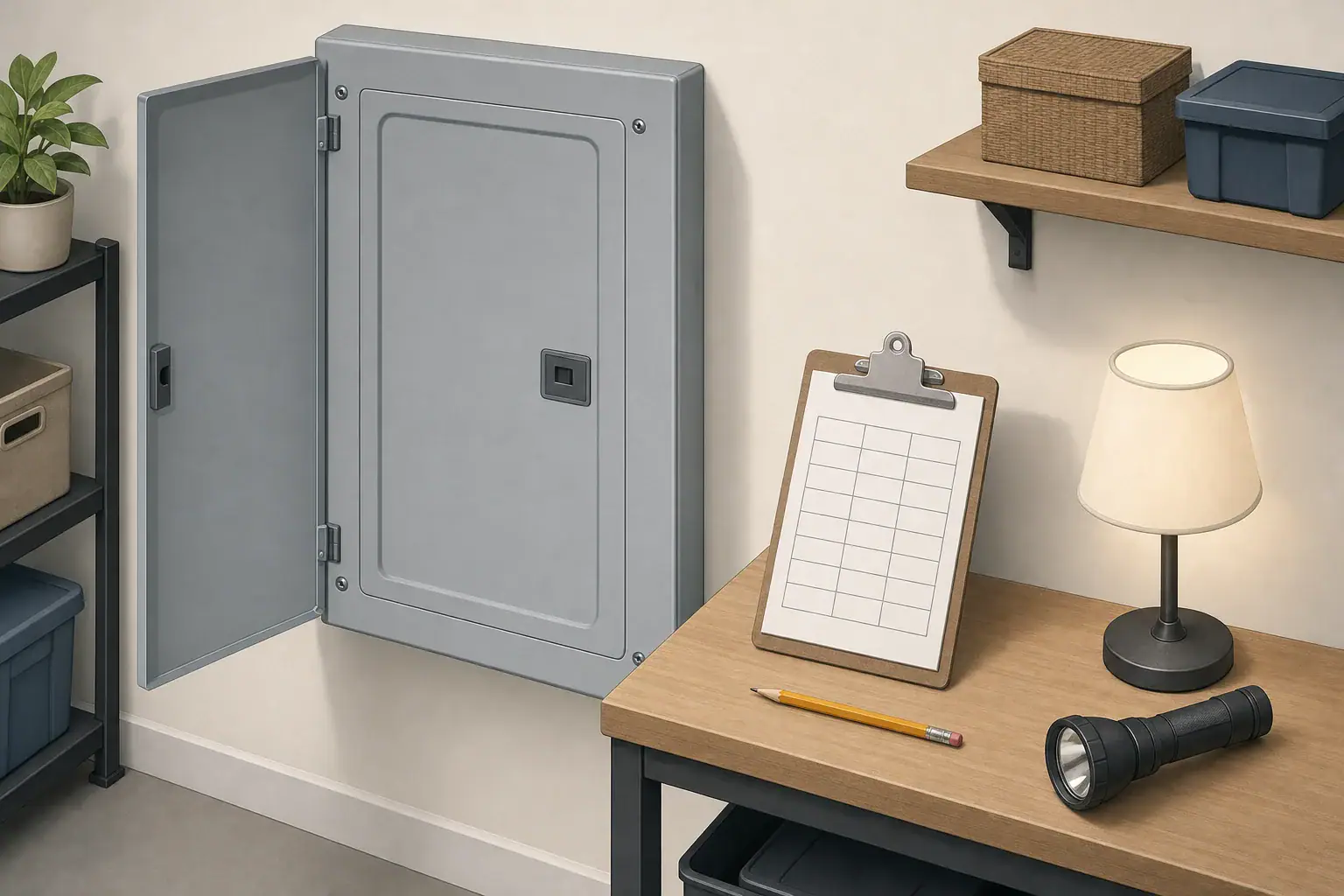
Quick answer: Create a circuit breaker map with the panel cover intact. Turn off one breaker at a time, use normal switches, accessible receptacles, and appliance controls to observe what loses power, then restore it. Record exact locations and mark each entry Verified, Partial, or Unknown. Do not guess or open equipment.
Make a circuit breaker map without opening the panel
A circuit breaker map is a record of what each breaker actually controls. It can make household planning easier before an outage, but it is not electrical repair guidance and does not create backup power.
Keep the panel cover, often called the deadfront, installed. Operate only breaker handles from outside the panel. The U.S. Consumer Product Safety Commission’s home-wiring safety guide says not to remove the service-panel cover; work inside the panel belongs to a qualified electrician.
Do not start if the panel is wet, visibly damaged, unusually hot, buzzing, sparking, scorched, or has a burning odor. Keep hands dry. Do not remove receptacle, switch, junction-box, appliance, or panel covers while tracing circuits.
Do not interrupt a circuit serving needed medical equipment or any load whose loss could create an immediate hazard. Ready.gov advises households to inventory electricity-dependent needs and make appropriate backup plans. For that broader task, see this medical device backup plan at home.
Prepare the circuit breaker map
- Tell everyone in the home that individual circuits may be briefly interrupted.
- Shut down computers, game systems, and other sensitive electronics normally before testing.
- Photograph the existing directory, even if you think it is wrong. It is a reference, not proof.
- Copy the physical breaker positions and markings exactly as they appear on the panel. Do not assume a numbering pattern.
- Gather a pencil, this worksheet, a working plug-in lamp, and a helper who can report observations from another area.
- List rooms and accessible areas, including hallways, closets, garage, basement, utility spaces, porches, and exterior receptacles.
- Check the original panel manufacturer’s instructions for the directory format and any equipment-specific cautions. If the panel is inaccessible or you do not have authority to operate it, ask the owner, manager, or a qualified electrician.
Trace one circuit at a time
- Choose one breaker. Turn off only its handle. Do not remove trim, covers, handle ties, or other parts.
- Check lights from normal controls. Note each ceiling, wall, closet, and exterior light that loses power.
- Check accessible receptacles. Use a working plug-in lamp at receptacles you can reach normally. If a receptacle is switch-controlled, test it only through its ordinary switch and plug-in use.
- Observe fixed loads without opening equipment. From normal controls or indicators, note equipment that loses power, such as a refrigerator, freezer, dishwasher, furnace control, well pump, sump pump, water heater, or garage-door opener. Do not disassemble or access any equipment to identify a circuit.
- Write down every observed result. One breaker can serve more than one room, and a single room can have separate lighting, receptacle, and fixed-load circuits.
- Restore the breaker before testing another. Confirm that the observed lights, receptacles, or equipment return to normal operation before marking the entry Verified.
- Stop for a problem. If a breaker trips, will not stay on, makes an unusual sound, gives off an odor, or produces conflicting results, leave it alone and contact a qualified electrician.
For linked or two-pole breakers, copy the actual handle arrangement and positions shown on the panel. Give independently operated handles their own rows. Do not separate linked handles or identify breaker types from appearance alone.
Write labels that someone else can use
Use a location plus a specific use. For example, write “Kitchen north-counter receptacles” rather than “Kitchen 2,” or “Primary bedroom lights and hall receptacle” rather than a resident’s name.
NFPA committee material addressing circuit directories calls for a clear, evident, and specific purpose or use that distinguishes one circuit from another. That material is not a statement of the code edition adopted where you live, but the labeling principle is useful: a future resident or electrician should not have to guess. See the NFPA committee material on circuit directories.
The U.S. Fire Administration also includes properly labeling electrical panel circuits among residential electrical fire-prevention practices and advises using qualified, licensed professionals for residential electrical work as applicable. See Residential Building Electrical Fires.
Use a verification status on every row
- Verified: You observed the listed lights, receptacles, or loads lose power and return when the breaker was restored.
- Partial: You confirmed at least one result, but some areas or equipment could not be checked.
- Unknown: You did not identify a controlled load. Keep any old label only as an unverified note.
Also flag household outage-relevant loads, such as refrigeration, a freezer, well or sump equipment, heating controls, communications equipment, charging locations, or electricity-dependent medical equipment. A flag identifies a planning priority only; it does not mean the circuit has backup power or is safe to interrupt.
How to handle mixed and unclear circuits
If one breaker affects several locations, list every observed location. If a room has several circuits, add each one to the reverse room index below. Do not simplify a mixed circuit to one room name.
For an unclear circuit, record what you tested and mark it Unknown or Partial. You can recheck accessible exterior, garage, closet, utility, basement, and attic-access areas using only normal switches, plugs, and controls. Hardwired or intermittent equipment may not show an obvious result.
Call a qualified electrician if a supposedly off circuit still appears energized, results conflict, the panel layout does not match its directory, or identification would require opening equipment. Do not tighten terminals, move breakers, or investigate wiring inside the panel. Manufacturer instructions for interior panel work are intended for qualified personnel; for example, Schneider Electric’s QO/Homeline support guidance directs users to identify breakers on the directory and reserves energized-equipment work for qualified persons.
Printable household checklist
- ☐ Existing directory photographed
- ☐ Actual breaker positions copied exactly
- ☐ Occupants notified
- ☐ Computers and sensitive devices shut down normally
- ☐ Lights checked in each accessible room and area
- ☐ Accessible receptacles checked
- ☐ Garage, exterior, storage, and utility areas checked
- ☐ Fixed appliances and equipment recorded from normal controls
- ☐ Household outage-priority loads flagged
- ☐ Mixed-room and partial-room circuits recorded accurately
- ☐ Unknown or conflicting circuits flagged for professional follow-up
- ☐ Final directory and detailed map dated and photographed
Printable panel-map template
Copy the panel’s actual position markings rather than renumbering the panel.
| Position | Handle or poles | Exact areas or loads | Priority flag | Status | Method | Date | Notes |
|---|---|---|---|---|---|---|---|
Reverse room index
Use this second list to show when a room has separate lighting, receptacle, and fixed-load circuits.
| Room or area | Lighting breaker | Receptacle breaker or breakers | Fixed-load breaker | Notes or unknowns |
|---|---|---|---|---|
When to recheck panel labels
Reverify affected map entries after electrical work, remodeling, a panel change, installation or removal of a major fixed appliance, or discovery of an incorrect label. Replace a directory that becomes faded, damaged, or hard to read.
There is no universal calendar interval established by the sources cited here. As a household recordkeeping practice, check that the directory remains present and legible when you review your readiness information. Keep the detailed map dated so future occupants know when the circuits were last observed.
Frequently asked questions
Can I make a circuit breaker map without removing the panel cover?
Yes. Keep the cover installed and use only external breaker handles, ordinary light switches, accessible receptacles, and normal appliance controls. The CPSC says homeowners should not remove the service-panel cover.
What should I do if I cannot identify a breaker?
Mark it Unknown, note what you checked, and do not guess. If identifying it would require opening equipment, if results conflict, or if an apparently off circuit still seems energized, contact a qualified electrician.
Which loads should I flag on the map?
Flag loads that matter to your household during an outage, such as medical equipment, refrigeration, freezer, well or sump equipment, heating controls, communications equipment, and charging locations. The flag is for planning, not a promise of backup power.
- Simple checklists and realistic planning
- Water, power, lighting, and pantry basics
- Family plans (kids, pets, seniors) and seasonal prep
Affiliate disclosure
As an Amazon Associate, we earn from qualifying purchases. Some links on this site may be affiliate links. If you buy through these links, we may earn a small commission at no extra cost to you. This helps support our content. Learn more.