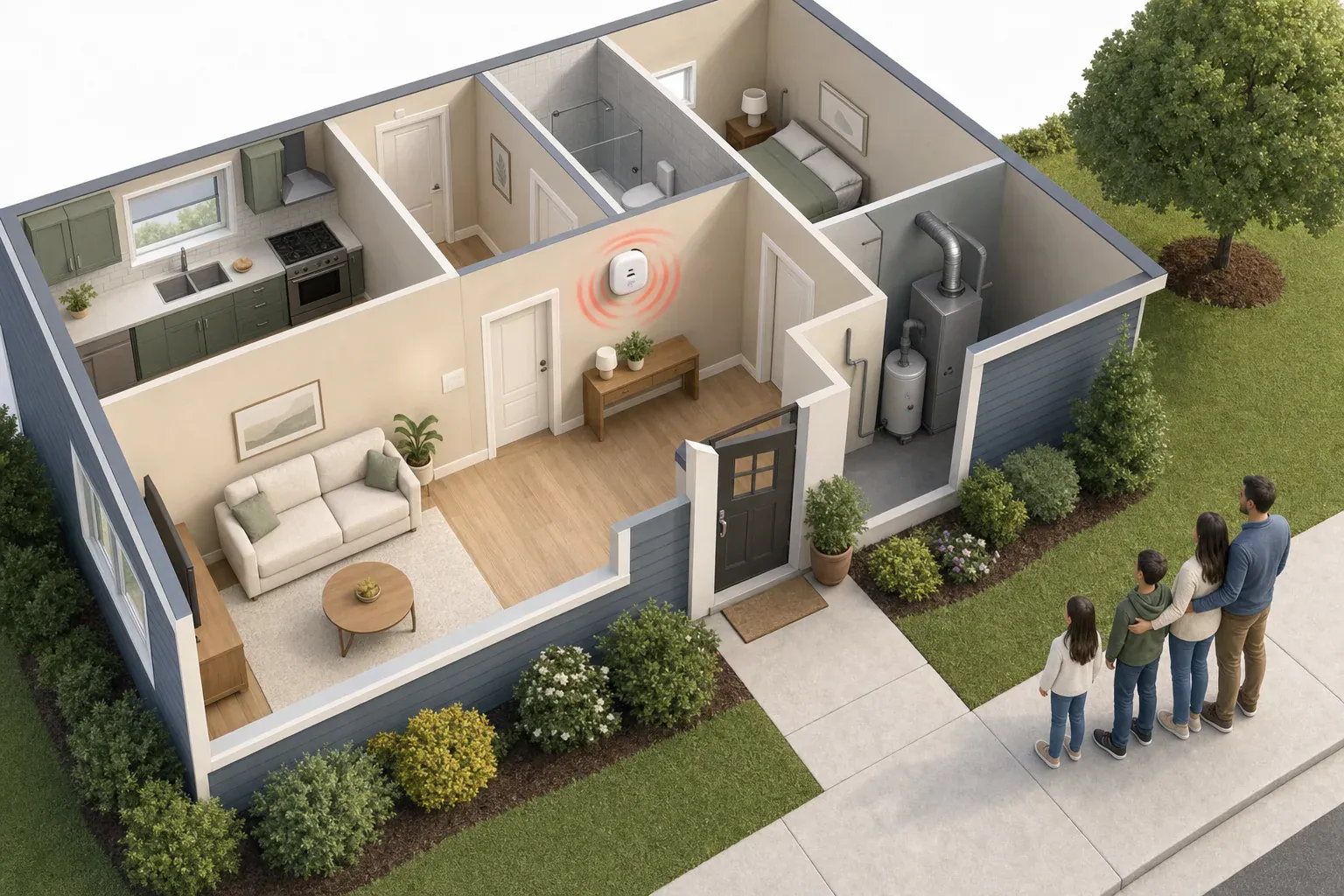
Quick answer: If a carbon monoxide detector is beeping with a confirmed CO warning—or you cannot confidently identify the sound as a maintenance chirp—take everyone outside, call 911 or local emergency services from outside, and stay out until responders say it is safe. Use the exact model manual only after reaching safety.
Carbon monoxide detector beeping: respond safely first
Do not assume the sound means a weak battery. If the alarm identifies carbon monoxide, gives a loud repeating warning, or cannot be confidently identified as a model-confirmed maintenance chirp, get everyone outside into fresh air. From outside, call 911 or local emergency services, account for everyone, and do not re-enter until responders say it is safe.
- Leave the home immediately with people and pets.
- Call 911, the fire department, or local emergency services from outside.
- Account for everyone and tell responders if anyone may still be inside.
- Stay out until responders authorize re-entry.
Do not search for the source first, and do not use a test or reset button to decide whether a current warning is real. The U.S. Consumer Product Safety Commission (CPSC) carbon monoxide fact sheet advises leaving the home, calling for help, accounting for people, and waiting for permission before returning.
Is it a CO alarm or a maintenance chirp?
There is no dependable beep count for every carbon monoxide alarm. A standalone CO alarm and a combination smoke-and-CO alarm can use different sounds, lights, display messages, icons, or voice alerts for CO, smoke, low battery, a fault, and end of life. Match the complete signal to the instructions for the exact model; do not rely on a remembered beep pattern.
| Sound category | Immediate action | Next verification step |
|---|---|---|
| Loud repeating warning, voice message, or display identifies CO | Leave, call 911 or local emergency services from outside, and remain out. | Follow responder instructions. Note the model details only after reaching safety. |
| The sound cannot be identified confidently | Treat it conservatively as a possible CO warning and leave. | From a safe location, find the exact model manual or contact the manufacturer. |
| A periodic chirp that the exact manual identifies as low battery | Follow the model instructions promptly. | Replace a battery only if the unit has a replaceable battery and the manual directs it; then follow the manual’s testing instructions. |
| A display, voice message, or manual identifies a fault or end-of-life signal | Restore reliable CO alarm protection promptly; do not rely on the affected unit. | Follow manufacturer support, service, or replacement instructions for that model. |
| A chirp continues after manufacturer-approved maintenance | Do not disable the alarm or invent a reset sequence. | Check the model-specific error information, date label, and manufacturer support guidance. |
A sound stopping does not by itself show that the home is safe. Likewise, no one feeling ill does not rule out exposure.
What to do after reaching a safe location
- Tell the dispatcher what happened. Provide the address and explain that a carbon monoxide alarm sounded.
- Account for people and pets. Tell responders if someone may still be inside.
- Report symptoms and follow medical instructions. The Centers for Disease Control and Prevention (CDC) lists possible symptoms including headache, dizziness, weakness, upset stomach, vomiting, chest pain, and confusion. These symptoms cannot confirm or rule out exposure.
- Wait for permission to return. Do not go back in because the sound stopped or a display changed.
- Keep identified problem equipment off. If responders identify a fuel-burning appliance as a possible source, do not operate it again until trained personnel have serviced it.
If the alarm activates again after authorized re-entry, leave again and contact emergency services. Directions from local authorities and qualified service professionals take priority over general online guidance.
How to identify the sound correctly
After authorities have approved re-entry—or if you have already confirmed from the exact manual that the sound is a maintenance signal—gather the details needed to interpret it accurately:
- Which device is making the sound
- Whether it is a standalone CO alarm or a combination smoke-and-CO alarm
- Brand and exact model number
- Whether the sound is a loud repeating warning or an isolated periodic chirp
- Light color and flashing pattern
- Any display message, icon, error code, or spoken message
- Whether the battery is replaceable or sealed
- The manufacture, installation, or replace-by date printed on the unit
Use the manufacturer’s official manual for the full model number. For example, original manuals for listed First Alert SC6/SM6 models and the Kidde KN-COP-DP-10YL-AQ-WF show why sound patterns must be read by model: their battery, fault, and end-of-life signals use different combinations of indicators and instructions. The Kidde example also has a sealed battery, so a routine battery replacement would not apply to it.
Match the sound with its associated light, display, icon, or voice message—not with one sound alone. Do not remove an actively alarming unit to inspect its back label while you are still in the home.
When to test, service, or replace the alarm
The CPSC recommends testing CO alarms monthly, while following the manufacturer’s instructions. A test button checks alarm circuitry; it does not establish that the CO sensor is accurately measuring the air.
- Test: Use only the procedure in the model instructions. Do not test an alarm instead of evacuating during an unexplained or confirmed CO warning.
- Replace a battery: Do this only when the manual identifies a low-battery signal and the unit has a replaceable battery. A sealed-battery model may require replacement of the complete alarm when its battery or end-of-life signal applies.
- Service or replace the unit: Follow the manual if it reports a fault, fails its prescribed test, is damaged, or reaches its stated replacement point.
- Replace at end of life: Use the date label, end-of-life indication, and product literature for that model. There is no single replacement interval that fits every CO alarm.
- Service fuel-burning equipment: If responders identify equipment as a possible source, keep it off until a qualified professional has inspected and serviced it.
For broader placement, battery-check, and routine-maintenance guidance, see smoke and CO alarms. Never remove a battery or disconnect an alarm simply to silence an unresolved warning.
Frequently asked questions
Can I stay inside to see whether a CO detector chirp stops?
No. If the sound is a confirmed CO warning or you cannot confidently identify it as a maintenance chirp using the exact model information, leave first and call for help from outside. A stopped sound is not proof that the home is safe.
Can I press the test or reset button when a CO alarm is sounding?
Do not use a test or reset button to decide whether an active warning is real. Evacuate first when the warning is confirmed or unclear. After the situation is safe, use only the procedures in the manual for the exact model.
Does a test button prove my carbon monoxide detector works?
No. CPSC explains that a test button checks the alarm’s circuitry, not the accuracy of its CO sensor. Continue to follow the manufacturer’s testing, service, and replacement instructions.
- Simple checklists and realistic planning
- Water, power, lighting, and pantry basics
- Family plans (kids, pets, seniors) and seasonal prep
Affiliate disclosure
As an Amazon Associate, we earn from qualifying purchases. Some links on this site may be affiliate links. If you buy through these links, we may earn a small commission at no extra cost to you. This helps support our content. Learn more.