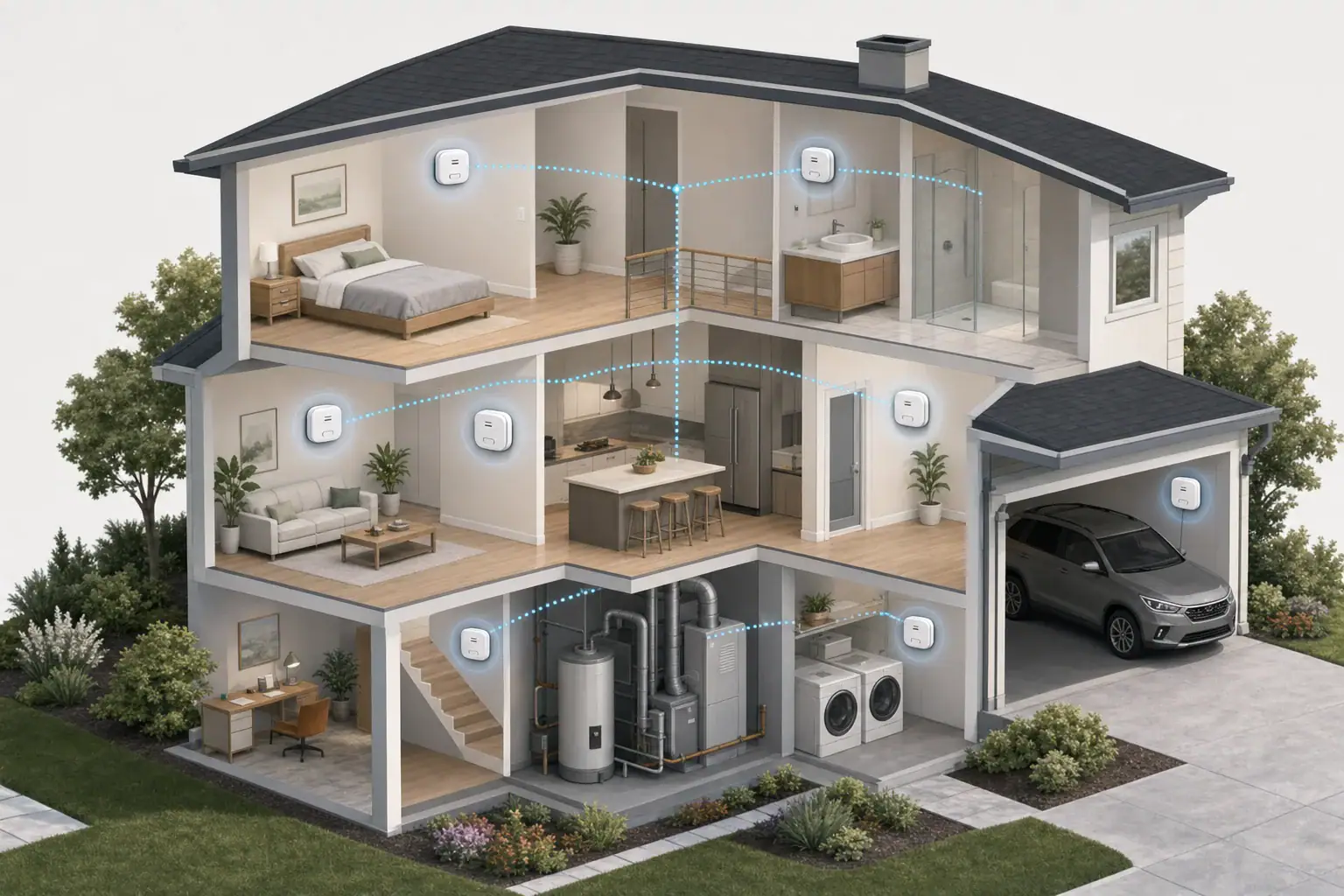
Quick answer: Choose carbon monoxide alarms for your home by checking local requirements and the home’s existing wiring first. Select a power option with the backup the model provides, confirm exact interconnection compatibility, and verify listing marks, accessible alerts, replacement instructions, and end-of-life signals in the manufacturer’s manual.
How to choose carbon monoxide alarms for home
Start with the dwelling, not a product-feature list. Identify the power source and alarm network already in place, then check the requirements that apply to the property. The U.S. Consumer Product Safety Commission (CPSC) advises choosing a CO alarm that meets UL 2034, using battery-operated alarms or backup power, and considering interconnected alarms so that one alarm can trigger the others.
Local rules can be more specific than national safety guidance. Before replacing installed alarms, especially in a rental or a home with wired alarms, ask the landlord, property manager, or local building or fire-code office what is allowed and required.
For a useful shopping comparison, record:
- Whether current alarms are battery-powered, plug-in, or hardwired
- The exact model numbers on existing alarms and any visible manufacture, installation, or replace-by dates
- Whether alarms use a wired interconnect, a wireless connection, or no interconnection
- Whether changing the system would require electrical work or permission from the property owner
- Whether anyone in the household needs visual, tactile, voice, or other accessible notification options
Match power and interconnection to the home
The right configuration depends on the home’s existing system and what can be installed lawfully and according to the product instructions. CPSC recommends battery-operated alarms or models with battery backup; for hardwired and plug-in units, that backup helps the alarm remain available if normal electrical power is interrupted.
| Configuration | Outage backup | Interconnection | Notification features | Setup considerations |
|---|---|---|---|---|
| Stand-alone battery alarm | Battery is the primary power source. | None unless the model specifically supports wireless interconnection. | Audible alarm; voice or display features vary by model. | Can suit a simpler retrofit, subject to local rules and rental permission. |
| Wireless-interconnected battery alarms | Battery is the primary power source. | Only with models the manufacturer identifies as compatible. | Connected alarms can sound together; features vary. | Check the exact model list, pairing process, stated range limits, and battery requirements. |
| Plug-in alarm with battery backup | Backup type and operation depend on the model. | Often stand-alone; some models offer a specified connection method. | Display, voice, or event-memory features may be available. | Use only an outlet and arrangement permitted by the manual, and confirm CO alarming works on backup power. |
| Hardwired alarm with battery backup | Battery backup is provided only if the selected model includes it and it is installed as directed. | May connect to a compatible existing wired network. | Whole-home audible alert; voice or location announcements vary by model. | Audit wiring and compatibility first. Electrical work may require a qualified electrician. |
| Combination smoke and CO alarm | Depends on the specific model and power arrangement. | Wired or wireless options vary by model. | Signals should let residents distinguish smoke and CO events. | The unit must meet applicable requirements for both hazards and be installed as its instructions allow. |
Do not assume units interconnect because they share a brand, shape, plug, or mounting base. Manufacturers may limit compatibility by model, generation, wiring connector, signaling method, and device type. Compare every character of the existing and proposed model numbers against the new alarm’s manual before buying.
A wired replacement is not automatically a do-it-yourself swap. Follow the manufacturer’s instructions and use qualified electrical help when required. For broader guidance on where alarms belong and how to maintain them after installation, see Smoke and CO Alarms: Placement, Battery Checks, and Maintenance.
When a combination smoke and CO alarm makes sense
A combination unit can be a practical choice when an approved installation point can serve both functions, local requirements permit it, and the unit fits the home’s existing alarm system. It can also simplify a like-for-like replacement when the installed system already uses compatible combination alarms.
It is not automatically the best choice for every location. Smoke and CO alarms address different hazards and do not replace one another. NFPA’s carbon monoxide educational guidance states that combination alarms should follow smoke-alarm installation directions. In practice, shoppers should verify that the proposed unit’s approved location, power arrangement, listing, interconnection method, and replacement instructions work for both functions.
Before selecting a combination unit, confirm all of the following in its labeling and manual:
- It is identified as listed for both smoke and carbon monoxide detection.
- The proposed location is permitted for both functions.
- It is compatible with any existing wired or wireless alarm network.
- Residents can tell apart smoke, CO, low-battery, trouble, and end-of-life signals.
- Any strobe, vibration device, receiver, or other accessibility accessory is documented to respond to the events the household needs it to report.
Labels, dates, and manual details to verify
Read the manual for the exact model under consideration, not a visually similar product. Save a copy before purchase if it is available. The following checks are more useful than relying on package claims alone.
- Listing and standard information: Look for the CO alarm’s UL 2034 conformance information and evidence of listing by a nationally recognized testing laboratory. For a combination unit, verify documentation for both the smoke and CO functions.
- Exact model number: Match letters, numbers, and suffixes when checking compatible alarms, wiring harnesses, bases, relays, and accessories.
- Normal and backup power: Confirm what supplies normal power, whether backup power is included, and what the manual says the unit does during an outage.
- Replacement instruction: Find the manufacturer’s service-life direction and end-of-life signal. A battery advertised for a certain lifespan does not by itself establish how long the alarm sensor is intended to remain in service.
- Date fields: Check the product label and instructions for manufacture, installation, and replace-by information. Record the installation date if the instructions direct you to do so.
- Signal patterns: Learn the differences between a CO alarm, smoke alarm, low-battery notice, malfunction signal, and end-of-life signal for that model.
- Operating limits: Review the approved locations, environmental limits, mounting restrictions, outlet restrictions, and circuit requirements stated in the manual.
- Connection limits: Confirm which models may connect, how many devices may be connected, and what pairing or wiring process is required.
There is no universal replacement age for every CO alarm. CPSC and NFPA both direct consumers to the product literature or manufacturer’s instructions and to the alarm’s end-of-life signal. Follow those model-specific directions.
Check accessible and remote notifications separately
Voice announcements, visual signals, vibration devices, receivers, and phone notifications do different jobs. A feature listed on the alarm package does not establish that it will meet a particular household member’s needs.
Review the manual for the alarm and for every accessory. Check which conditions it reports, whether it reports smoke and CO separately, what it needs to operate, and whether its function changes during a power or internet outage. As one example of why this review matters, the First Alert SMCO100V-AC manual says that its voice/location combination unit does not itself alert hearing-impaired residents and points users to appropriate special-purpose devices. That statement applies to that model; other products and accessories must be checked individually.
Remote notifications can be useful supplemental information, but they should not be assumed to replace the alarm’s local audible or accessible notification method unless the product documentation and applicable local requirements specifically support that use.
Special note for manufactured homes
Manufactured homes covered by the federal construction standard have specific requirements. Under 24 CFR 3280.211, required CO alarms must bear evidence of UL 2034 conformance; where multiple alarms are required, they must interconnect. The rule also addresses electrical primary power with battery secondary power and permits combination units when smoke-alarm requirements are met.
Those federal provisions apply to manufactured homes covered by that rule. They are not a universal specification for every existing site-built home, apartment, or renovation. Confirm the requirements for the particular property with the relevant local authority or property owner.
Use a final pre-purchase checklist
- Check local requirements and, if applicable, rental or association rules.
- Photograph current alarm labels before shopping.
- Choose a power arrangement that works with the home and provides the backup stated in the product documentation.
- Confirm interconnection only from the manufacturer’s exact compatibility list.
- For a combination unit, verify that one approved setup satisfies both smoke and CO requirements.
- Verify listing information, event signals, accessibility support, service-life instructions, and end-of-life behavior.
- Save the manual, model number, installation date, compatible-device list, and replacement instruction with household records.
- Simple checklists and realistic planning
- Water, power, lighting, and pantry basics
- Family plans (kids, pets, seniors) and seasonal prep
Affiliate disclosure
As an Amazon Associate, we earn from qualifying purchases. Some links on this site may be affiliate links. If you buy through these links, we may earn a small commission at no extra cost to you. This helps support our content. Learn more.