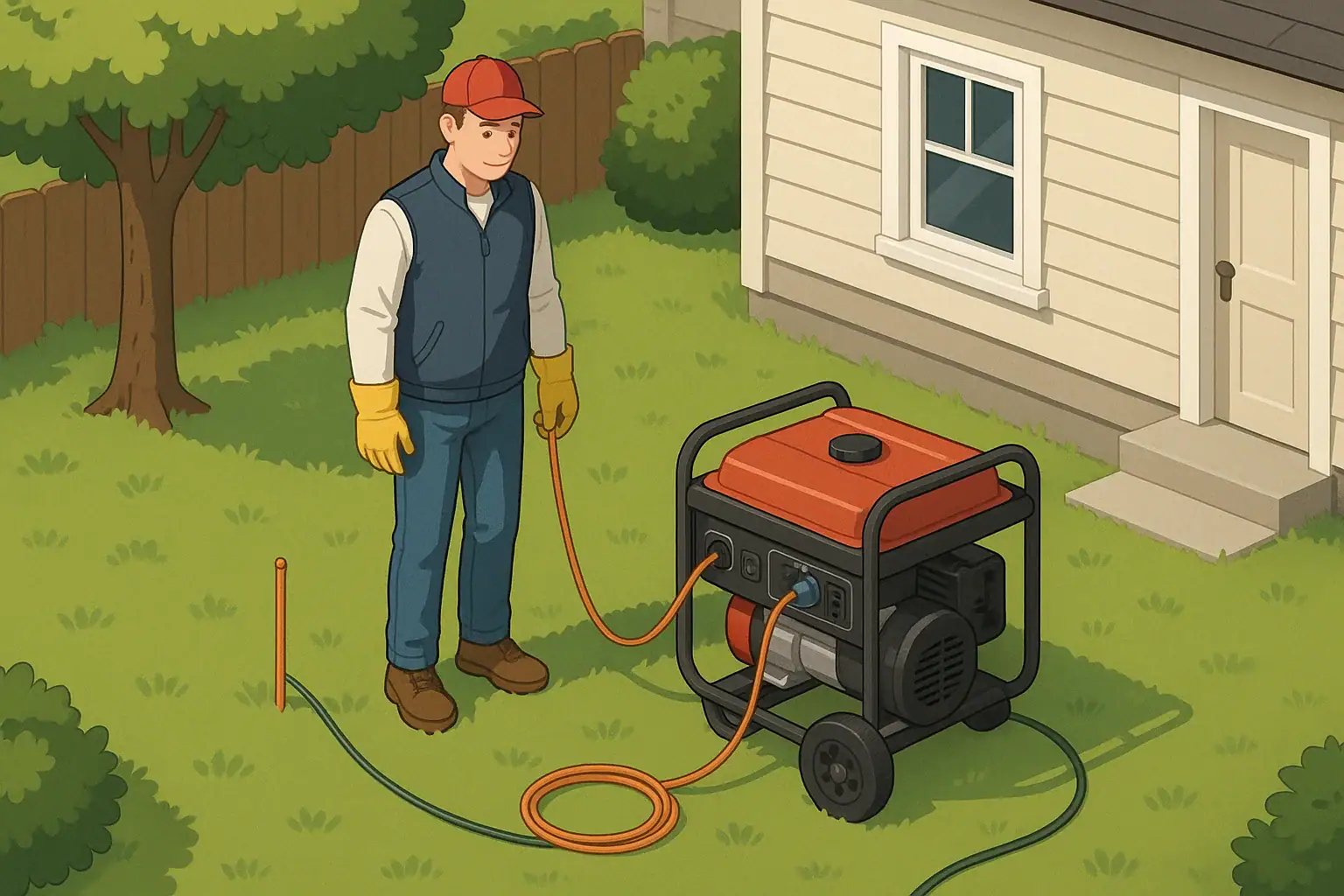
Do you need to ground a portable generator?
Whether you must drive a ground rod for a portable generator depends on how you are using it and how the generator is built. In many common home backup situations, a separate ground rod for the generator itself is not required. In other setups, it can be required by electrical code and by safety guidance.
In plain terms:
- Using cords directly from the generator to appliances (no transfer switch, no connection to the house panel): most modern portable generators do not need a separate ground rod, as long as they are used as the manufacturer describes and plugged into properly grounded equipment.
- Connecting the generator to your home wiring through a transfer switch or interlock: grounding and bonding must follow electrical code. In many cases, the generator must be treated like a separately derived system, which can require a neutral-to-ground bond and a grounding electrode (ground rod) at the house service, not at the portable generator frame. This is work for a qualified electrician.
Always confirm with your generator manual, local electrical code, and a licensed electrician. The guidance below explains why grounding matters and how to recognize the common setups.
Key terms: grounding, bonding, and neutral
Understanding a few basic terms makes the rules easier to follow:
- Grounding (earthing) means connecting parts of the electrical system to the earth, usually through a grounding electrode such as a ground rod. This helps limit voltage during faults and lightning.
- Bonding means connecting metal parts together so they stay at the same electrical potential. For generators, the important bond is usually between the neutral conductor and the metal frame or equipment grounding conductor.
- Neutral is the grounded conductor that normally carries return current in a 120/240‑volt system.
- Floating neutral generator has no internal connection between neutral and the frame. The neutral “floats” with respect to the generator chassis.
- Bonded neutral generator has the neutral connected (bonded) to the frame inside the generator.
Grounding and bonding rules are based on whether the generator is floating or bonded, and whether it is stand‑alone or tied into a building system.
When a portable generator usually does not need a ground rod
For many households, the simplest and safest way to use a portable generator is as a stand‑alone source, powering only what you plug directly into it. In this common case, a separate ground rod for the generator is usually not required when all of the following are true:
- You plug appliances or power strips directly into the generator outlets, or through heavy‑duty outdoor‑rated extension cords.
- You are not backfeeding or connecting the generator to your home breaker panel.
- You follow the manufacturer’s instructions for grounding and bonding.
- The generator is placed outdoors on a dry, stable surface, away from standing water.
In this setup, the generator frame and the equipment grounding conductors in the cords provide the fault path needed for breakers or built‑in protection to trip. A separate rod at the generator usually does not improve safety and can create confusing parallel paths for fault current.
The OSHA portable generator safety quick card notes that, for certain portable generators supplying only equipment through receptacles on the generator, a separate grounding electrode is not required when specific conditions are met. Home use is not the same as a jobsite, but the principle is similar: many portables are designed to operate safely without a separate rod when used as intended.
When grounding and bonding become more complex
Grounding and bonding become more critical when you connect a portable generator to your home wiring. In these cases, the generator and your house electrical system must work together safely.
Using a transfer switch or interlock
If you connect a portable generator to your home through a manual transfer switch or panel interlock, you are effectively turning the generator into a temporary power source for part of your house. Now you must consider:
- Where the neutral is bonded to ground (at the main panel, at the generator, or both).
- Whether the generator is treated as a separately derived system under electrical code.
- How fault current will return to trip breakers quickly.
These details are governed by the National Electrical Code (NEC) as adopted in your area and by your local authority having jurisdiction (AHJ). The wrong setup can create shock hazards or nuisance tripping. A licensed electrician should design and install any transfer switch or interlock and confirm the correct grounding and bonding arrangement for your specific generator model.
Never backfeed through a dryer or range outlet
Backfeeding a house by plugging a generator into a dryer or range outlet is dangerous and often illegal. It can energize utility lines and endanger lineworkers and neighbors. It also bypasses proper grounding, bonding, and overcurrent protection. Use only a properly installed transfer switch or interlock.
For safe backup power planning, see the Ready.gov guidance on power outages and consult local code officials or a qualified electrician.
How to tell if your generator has a bonded or floating neutral
Before deciding how to ground your generator, find out whether it has a bonded or floating neutral. Do not guess; different models from the same brand can be built differently.
Steps to check:
- Read the owner’s manual carefully. Look for sections labeled “grounding,” “bonding,” “neutral,” or “wiring diagram.” Many manuals state whether the neutral is bonded to the frame.
- Check the nameplate or labels on the generator. Some units are marked “neutral bonded to frame” or “floating neutral.”
- Contact the manufacturer with the exact model number if the manual is unclear. Ask directly whether the neutral is bonded to the frame and how the unit is intended to be grounded when used with a transfer switch.
- Have an electrician test it if needed. A qualified person can use a meter to verify the relationship between neutral and frame, but this should be done safely with the generator off and disconnected.
Once you know the neutral type, your electrician can decide how to integrate the generator with your home system, including whether a neutral‑ground bond belongs in the generator or only in the main service equipment.
Basic grounding and safety steps for home use
Grounding is only one part of safe generator use. For household readiness, focus on a complete safe setup:
- Follow the manual first. The manufacturer’s instructions override general advice. If the manual calls for a frame connection to a ground rod in certain uses, follow that guidance or ask an electrician.
- Use outdoor‑rated cords. Choose heavy‑duty, three‑wire (with ground) extension cords sized for the load and length. Keep cords out of water and away from trip hazards.
- Place the generator outdoors only. The U.S. Consumer Product Safety Commission warns that generators must never be used inside homes, garages, basements, crawlspaces, or partially enclosed areas because of carbon monoxide (CO) risk. See the CPSC portable generator safety information for details.
- Keep it far from openings. Position the generator outside, away from doors, windows, vents, and attached garages so exhaust cannot enter the home.
- Install CO alarms. The CDC carbon monoxide safety guidance recommends battery‑operated or battery‑backed CO detectors near sleeping areas and on every level of the home.
- Protect from moisture. Do not run a generator in rain or snow without a properly designed, open‑sided shelter that keeps water off the unit while maintaining full ventilation. Never cover or enclose it in a way that traps exhaust.
- Turn off before refueling. Let the engine cool before adding fuel to reduce fire risk.
- Have an electrician handle panel connections. Any connection to your home wiring, including transfer switches and inlet boxes, should be installed and inspected by a licensed electrician familiar with local code.
When to add a ground rod for a portable generator
Situations where a ground rod may be required or recommended include:
- Jobsite or commercial use where OSHA or local rules require a grounding electrode for certain configurations.
- Temporary structures (such as some RV or construction setups) where the generator is treated as a separately derived system.
- Specific manufacturer instructions that call for a frame connection to a grounding electrode in certain modes of operation.
For home backup, the grounding electrode system for your house (ground rods, water pipe bonding, etc.) is normally part of the permanent electrical installation, not something you add at the generator itself. Adding an extra rod at the generator without understanding the whole system can create unwanted current paths.
If you believe a ground rod might be needed, ask a licensed electrician to review your setup, including:
- Your generator model and neutral type.
- How you plan to connect it (cords only, transfer switch, interlock, RV inlet, etc.).
- Your existing home grounding electrode system.
- Local code requirements and utility rules.
Practical readiness tips for families using generators
Grounding and bonding can feel technical, but a few practical habits make generator use safer and less stressful during an outage:
- Decide your connection method in advance. Will you run a few cords to key appliances, or power part of the house through a transfer switch? Plan and install before storm season.
- Label what the generator will power. Mark which circuits or appliances you will run so you do not overload the generator in an emergency.
- Store fuel safely. Keep fuel in approved containers, away from living areas, ignition sources, and children. Follow local rules for storage limits.
- Practice a dry run. On a clear day, test starting the generator, plugging in loads, and shutting it down. Confirm everyone who may use it knows the basics and understands that it must stay outdoors.
- Keep documentation handy. Store the generator manual, transfer switch paperwork, and electrician’s notes in a waterproof folder near the main panel.
- Plan for accessibility. If anyone in the household has mobility, hearing, or vision challenges, think through who can move the generator, refuel it, and respond to alarms.
Frequently asked questions
Do I need to ground my portable generator with a rod at home?
In many home situations where you plug appliances directly into the generator and do not connect it to your house panel, a separate ground rod at the generator is usually not required if you follow the manufacturer’s instructions. When the generator is tied into your home wiring through a transfer switch or interlock, grounding and bonding must follow electrical code, and you should rely on a licensed electrician to decide whether any additional grounding is needed.
Can I connect my portable generator to my house without an electrician?
Running extension cords from the generator directly to appliances is something many homeowners can do safely if they follow the manual and basic safety rules. Any connection to your home electrical panel, including transfer switches, inlet boxes, or interlocks, should be designed and installed by a licensed electrician and inspected as required by local code.
Is it safer to add a ground rod “just in case”?
Not necessarily. Adding a ground rod at the generator without understanding the whole electrical system can create parallel paths for fault current and may not improve safety. It can also conflict with code requirements. It is better to follow the generator manual and have an electrician review your specific setup than to add a rod “just in case.”
How far from the house should I place a portable generator?
Guidance varies, but safety agencies emphasize keeping generators outdoors and away from doors, windows, and vents to reduce carbon monoxide risk. The U.S. Consumer Product Safety Commission and CDC both stress that generators should never be used inside homes, garages, or other enclosed or partially enclosed spaces. Follow your manual and local guidance, and when in doubt, increase distance and improve ventilation.
- Simple checklists and realistic planning
- Water, power, lighting, and pantry basics
- Family plans (kids, pets, seniors) and seasonal prep
Affiliate disclosure
As an Amazon Associate, we earn from qualifying purchases. Some links on this site may be affiliate links. If you buy through these links, we may earn a small commission at no extra cost to you. This helps support our content. Learn more.