Short power outages are common in many parts of the United States, especially during winter storms, hurricanes, summer heatwaves, and high wind events. For most households, losing power is an inconvenience more than a crisis, but it can still disrupt communication, lighting, and access to basic information.
Small solar panels and battery banks have become a practical way to keep phones, small lights, and a few essentials running during these short-term emergencies. They are not a full replacement for grid power, but they can help you:
- Charge phones to stay in contact and receive updates
- Run small LED lights for safe movement at night
- Top up rechargeable batteries for flashlights or radios
- Extend the runtime of a small power station for basic devices
A key question for many people, especially in apartments or dense neighborhoods, is where solar charging will actually work: indoors near a window, on a balcony, or only outside in full sun. Understanding the strengths and limits of solar charging in different locations helps you plan realistically and avoid disappointment when you need it most.
Why Solar Charging Matters for Everyday Emergencies
Short power outages are common in many parts of the United States, especially during winter storms, hurricanes, summer heatwaves, and high wind events. For most households, losing power is an inconvenience more than a crisis, but it can still disrupt communication, lighting, and access to basic information.
Small solar panels and battery banks have become a practical way to keep phones, small lights, and a few essentials running during these short-term emergencies. They are not a full replacement for grid power, but they can help you:
- Charge phones to stay in contact and receive updates
- Run small LED lights for safe movement at night
- Top up rechargeable batteries for flashlights or radios
- Extend the runtime of a small power station for basic devices
A key question for many people, especially in apartments or dense neighborhoods, is where solar charging will actually work: indoors near a window, on a balcony, or only outside in full sun. Understanding the strengths and limits of solar charging in different locations helps you plan realistically and avoid disappointment when you need it most.
How Solar Charging Actually Works in Emergencies
Solar panels convert light into electricity. In simple terms, the more direct and intense the sunlight, the more power you get. Cloud cover, window glass, dirt, and the angle of the panel all reduce output.
For emergency use, most households are working with small solar setups, such as:
- Foldable solar panels that plug into a power bank or small power station
- Rigid panels mounted on a balcony or placed in a sunny spot when needed
- Built-in mini panels on some lights or small devices
Because these setups are relatively small, it helps to think in terms of priorities: which devices truly matter during an outage, and how much power they use. Typical emergency priorities include:
- Phones and basic communication devices
- A compact radio
- Small LED lanterns or flashlights with rechargeable batteries
- Possibly a small fan in hot climates, if capacity allows
Large appliances like refrigerators, air conditioners, or electric heaters generally require much more power than small solar panels can provide. For those, households often rely on grid power, larger generators, or non-electric alternatives, depending on local conditions and building rules.
Example values for illustration.
| Home situation | Indoor window charging | Outdoor/balcony charging | Planning note |
|---|---|---|---|
| North-facing apartment, shaded street | Low output | Limited options | Focus on pre-charged power banks and low-use devices |
| South-facing apartment with big windows | Moderate mid-day output | Balcony better if allowed | Test panel at different times of day |
| House with small yard | Works in bright windows | Best results in open sun | Use outdoor spot when home; bring panel in at night |
| Townhouse with shared outdoor space | Useful but reduced | Possible if rules permit | Check building rules and avoid blocking walkways |
| High-rise with balcony rail | Good for top-ups | Attach safely and securely | Never hang panels loosely over edges |
| Rural home with open sky | Supplemental only | Strong option in clear weather | Consider a routine outdoor charging spot |
Outdoor Solar Charging: Best Performance and Key Trade-Offs
Outdoors in direct sun is where solar panels perform best. If you have a yard, driveway, patio, or balcony with clear sky exposure, this is usually the most effective way to recharge your emergency batteries during the day.
When Outdoor Solar Charging Works Well
Outdoor placement is most effective when you have:
- Several hours of unshaded sun, especially mid-day
- A way to angle the panel roughly toward the sun
- Enough space so the panel is not a trip hazard
- Weather calm enough to keep the panel secure
Even on hazy or lightly cloudy days, outdoor panels typically outperform indoor window placement. In many parts of the country, a few hours of decent outdoor sun can provide enough power to recharge several phones or a small power bank, depending on panel size.
Practical Outdoor Setup Tips
For short-term emergencies, most people use a temporary setup rather than permanent mounting. Consider:
- Angle: Prop the panel up so it generally faces the sun. Perfection is not required; getting it roughly pointed at the sun is usually good enough for emergency charging.
- Stability: Anchor the panel with small weights or tie-downs so wind will not flip it or move it into a walkway.
- Location: Place it where children and pets will not trip over cords. Avoid driveways if vehicles may be moving.
- Security: In shared or visible areas, keep the panel where you can see it or bring it back indoors when you are not nearby.
If rain is likely, bring your equipment indoors. Many panels can tolerate light weather, but cords, connectors, and power banks are more vulnerable to moisture.
Outdoor Limitations and Safety Considerations
Outdoor solar charging has a few trade-offs:
- Weather dependency: Heavy clouds, smoke, or storms can reduce output significantly.
- Supervision: You may not want to leave equipment unattended in some areas.
- Heat: On very hot days, avoid placing panels directly on surfaces that become extremely hot, such as dark metal, to reduce stress on components.
- Building rules: In apartments and condos, balconies may have restrictions. Hanging panels outside railings is often not allowed and can be unsafe.
Check any local rules or building policies before mounting panels in shared or common areas.
Indoor Solar Charging: What Actually Works Behind Glass
Many people hope to charge solar panels entirely indoors, especially when outdoor access is limited or building rules are strict. While indoor solar is possible, it is usually slower and less efficient than outdoor charging.
Solar Panels at a Window
Standard window glass reduces the amount of light reaching a panel. Tinted or double-pane windows reduce it even further. That means a panel rated for a certain maximum output outdoors may produce only a fraction of that behind glass.
Factors that improve indoor performance include:
- Orientation: South-facing windows in the U.S. usually receive the most midday sun.
- Window size: Larger, unobstructed windows allow more light.
- Clean glass: Dust and dirt cut light further; a clean window helps slightly.
- Panel placement: Placing the panel as close to the glass as possible, without damaging it, can improve output.
Even with a good window, expect indoor solar to be a “top-up” method rather than a primary power source. It may be enough to slowly recharge a power bank or keep phones topped off over the course of a sunny day, but it is unlikely to support heavier loads.
Can Room Lights Power Solar Panels?
Typical indoor lighting is not strong enough to produce meaningful power from small solar panels. While some very small devices with built-in panels can slowly recharge under bright artificial light, this is usually too slow to matter in an emergency, and it wastes power from your already limited electricity sources.
In a power outage, if your lights are off, there is no artificial light to work with anyway. For planning purposes, assume that useful solar charging comes from sunlight, not from regular indoor lamps.
Apartment-Friendly Indoor Strategies
If you only have windows and cannot easily go outside, you can still make solar a helpful supplement by planning ahead:
- Test your panel in your brightest window on a sunny day and note how long it takes to recharge a small power bank.
- Keep shades or curtains open when you want to charge, and move the panel slightly as the sun angle changes, if convenient.
- Combine indoor solar with pre-charged batteries, so solar is extending your runtime rather than starting from empty.
This testing helps you build realistic expectations for your specific home layout, rather than relying on general claims.
Planning Backup Power: Phones, Lights, and Essential Devices
Solar charging is just one part of a simple emergency power plan. To use it effectively, match your solar capability to the devices you truly need during a short outage.
Prioritizing Devices
Most households benefit from grouping devices into three levels:
- High priority: Mobile phones, a basic radio, home internet modem or router (if your provider still has service and you have sufficient power), small medical or accessibility devices as advised by a professional
- Medium priority: LED lanterns, small fans, tablets for information and children’s entertainment
- Low priority: Laptops for non-essential use, gaming devices, small appliances
In a limited-power situation, it is often better to keep high-priority, low-wattage devices running reliably rather than trying to power many things at once.
Role of Power Banks and Small Power Stations
Solar panels are most useful when paired with some form of energy storage, such as:
- USB power banks for phones and small lights
- Rechargeable AA/AAA batteries with a USB charger
- Small portable power stations for multiple devices
During sunny hours, you use the solar panel to charge the battery bank or power station. Then you use that stored power throughout the day and night as needed. This helps buffer the natural ups and downs of solar output and avoids having to sit near a panel with your phone attached for hours.
Simple Runtime Expectations
Exact runtimes vary based on device settings, battery sizes, and how often you use each device. As a general planning habit:
- Turn on battery saver modes on phones and tablets.
- Lower screen brightness and close unneeded apps.
- Use wired charging instead of wireless charging to reduce losses.
- Use small LED lights rather than large, bright fixtures.
These habits stretch the energy you do have, making your limited solar charging more effective.
Seasonal and Regional Considerations for Solar Readiness
Where you live and when outages are most likely in your area strongly affect how well solar will work for you.
Winter Storms and Short Days
In northern states, winter storms often cause outages when days are short and the sun sits low in the sky. Snow and cloud cover can reduce solar output, but snow can also brighten the environment by reflecting light.
For winter-focused planning:
- Expect fewer hours of usable sunlight each day.
- Angle panels more steeply to face the lower sun if using them outdoors.
- Prioritize energy-efficient lighting and communication over other uses.
Summer Heatwaves and Hurricanes
In many southern and coastal regions, summer storms and hurricanes are a primary outage concern. These events can bring many cloudy or rainy days in a row, which limits solar performance, but they also occur during seasons with long daylight hours.
For these situations:
- Take advantage of every sunny break between storm bands to recharge.
- Consider shading for both people and panels; very high temperatures can stress electronics.
- Think through non-electric cooling strategies as well, such as ventilation and light clothing.
Wildfire Smoke and Air Quality Days
In regions affected by wildfires, smoke can dim the sun and reduce solar output. You may also want to keep windows closed for comfort. In these situations:
- Expect reduced solar charging efficiency on smoky days.
- Use any clear-sky periods to fully charge power banks in advance, if you know a smoke event is possible.
- Balance the need for outdoor panel use with guidance from local authorities about outdoor air quality and personal safety.
Building a Simple, Calm Solar-Ready Routine
Solar charging for emergencies works best when it is part of your normal routine rather than an unfamiliar tool you only see during a blackout.
Test Your Setup Before You Need It
Ahead of storm season or known high-risk periods:
- Charge all power banks and test every cable.
- On a sunny weekend, try a full “solar day” where you charge your devices only from your panel and stored battery.
- Note how long it takes to recharge each item under your real conditions, both indoors and outdoors.
This low-stress testing helps you adjust your expectations and decide whether to add another power bank, a small lantern, or a different panel placement to your plan.
Storing and Caring for Your Solar Gear
Proper storage makes your equipment more reliable:
- Keep panels in a dry, easy-to-reach location, such as a closet near a window or door.
- Store power banks partially charged if they will sit unused for long periods, and top them off every few months.
- Bundle charging cables with simple labels or colored bands so you can find the right connector quickly in low light.
During an actual outage, you will appreciate not having to search through drawers for the right cable or adapter.
Example values for illustration.
| Device type | Illustrative watt range | Planning notes |
|---|---|---|
| Mobile phone charging | 5–10 watts | Short, infrequent charges; prioritize messages over streaming |
| Small LED lantern | 3–8 watts | Use lowest brightness that is still safe and comfortable |
| Battery-powered radio via charger | 5–15 watts | Charge during the day; listen at low volume |
| Tablet for limited use | 10–20 watts | Reserve for information or brief entertainment sessions |
| Small USB fan | 3–10 watts | Use only as needed; combine with open windows when safe |
| Internet modem/router | 10–25 watts | Run only if service is available and power budget allows |
Key Takeaways for Indoor vs Outdoor Solar Use
Solar charging can be a steady, low-stress support for your emergency plan rather than a cure-all. Outdoors in direct sun, panels provide the most useful power and can meaningfully recharge phones, lights, and small power banks. Indoors, even in bright windows, solar is usually slower and better suited to topping up stored power rather than driving larger loads on its own.
By testing your specific home conditions, combining solar panels with modest battery storage, and focusing on low-power essentials, you can make solar charging a practical part of staying connected and comfortable during ordinary short-term outages.
Frequently asked questions
Can I charge a phone from a solar panel indoors through a window?
Yes, but output is reduced by window glass and is typically much slower than outdoor placement. In a large, south-facing clean window on a sunny day a panel may top up a phone or slowly charge a power bank over several hours, but it is unlikely to be a primary source. Test your specific window and panel to set realistic expectations.
How much solar wattage do I need to recharge a phone reliably during a day?
A typical phone draws about 5–10 watts while charging; to recharge from empty in a few hours under good sun, a 20–30 watt panel is a practical starting point. Allow for losses from connectors and charging circuitry, and expect slower results in non-ideal conditions. Pairing panels with a power bank improves reliability.
Is it safe to leave solar panels charging outdoors unattended?
Not always—outdoor setups face risks from weather, theft, and accidental damage. Secure and anchor temporary panels, protect connectors from moisture, and bring equipment inside during rain or high winds. Also follow any building or HOA rules about visible equipment on balconies or shared spaces.
Will solar charging work on cloudy or smoky days?
Solar panels still produce power under light cloud cover, but output can drop substantially depending on cloud density or smoke levels. Expect much slower charging and rely on pre-charged batteries when poor air quality or extended cloudy conditions are likely. Use clear breaks in conditions to top up power banks whenever possible.
What’s the most effective way to use solar panels with power banks during an outage?
Charge power banks during daylight so stored energy is available overnight or during cloudy periods, rather than keeping devices tethered to panels. Use appropriate cables and a regulated input or charge controller to avoid inefficient charging or damage. Keep power banks partially charged in storage and label cables for quick deployment.
Recommended next:
- Blackout Plan (Apartment / House): Step-by-Step Checklist for the First 24 Hours
- Blackout Plan for Apartments: What to Do When the Power Goes Out
- Blackout Plan for Houses: What to Do When the Power Goes Out
- Backup Power Basics: Watts vs Watt-Hours and Why It Matters
- How to Estimate Runtime for Your Devices (Without Guessing)
- Load Priorities: What to Power First in an Outage
- More in Blackouts & Backup Power →
- Simple checklists and realistic planning
- Water, power, lighting, and pantry basics
- Family plans (kids, pets, seniors) and seasonal prep
Backup Power Costs Explained: One-Time Gear vs Ongoing Fuel and Batteries
Backup Power Maintenance: Monthly Checks and Seasonal Prep
Lighting Strategy for Outages: Zone Your Home for Safety and Comfort
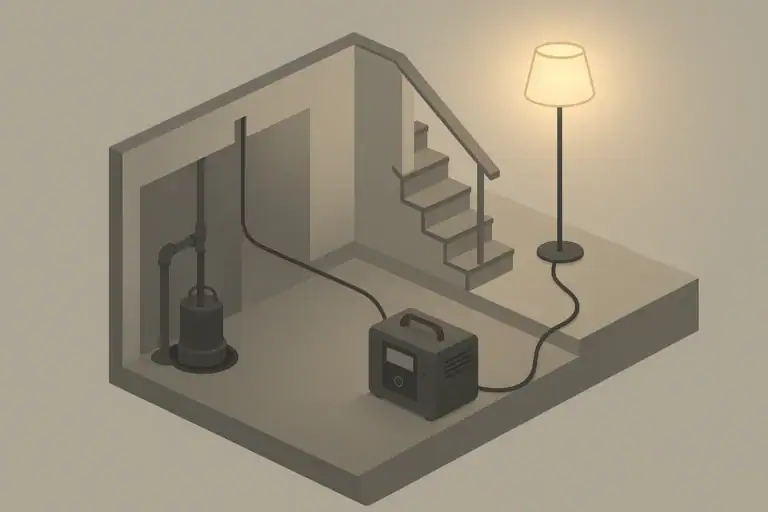
Sump Pump Backup Options: Planning for Basement Flood Risk
Water and Power: What Stops Working in Most Homes During Outages
Can You Run a Microwave, Kettle, or Space Heater on Backup Power? Reality Check