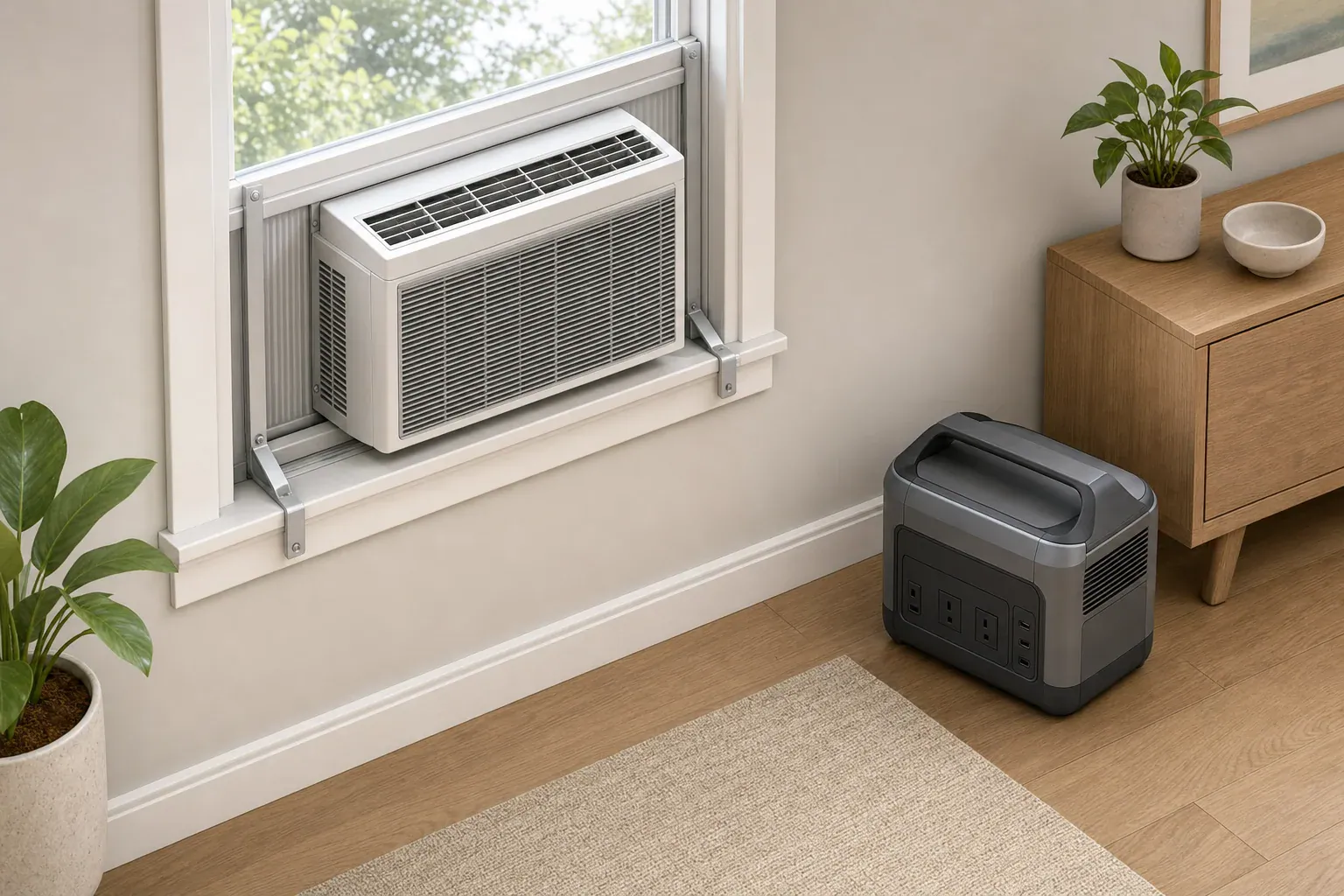
Quick answer: A power station can run some window air conditioners when its AC output matches the unit’s electrical requirements, its continuous output covers the running load, and its surge capability supports compressor startup. Battery capacity determines runtime. If startup information or surge duration is missing, compatibility is unknown.
Window air conditioner backup power: check four things first
A window AC is compatible with a portable power station only when the specific appliance and station pass all four checks below. BTU rating, battery watt-hours, and an advertised peak-output number cannot answer the question by themselves.
- Match the electrical supply. Compare the AC nameplate and manual with the station’s AC output: voltage, frequency, plug/receptacle type, and grounding requirements.
- Compare running load with continuous output. The station’s continuous AC-output rating must exceed the AC’s documented running load plus every other load connected to the station.
- Check compressor startup. The station’s surge capability and permitted surge duration must fit the AC’s documented starting requirement under conditions allowed by both manufacturers.
- Estimate usable energy. Use the battery’s watt-hours and a clearly stated allowance for conversion losses and other operating limits to estimate runtime.
Capacity and output are different specifications. For example, the EcoFlow DELTA 2 manual lists battery capacity, total AC output, and surge output separately and instructs users to keep total loaded-device power below rated power. A large battery does not make an undersized inverter able to start a compressor, and a station that starts an AC may still have limited runtime.
Do not treat a boost, peak, or surge mode as proof that a compressor will start unless the power-station manufacturer specifically supports that use with the appliance in question.
Use this window AC and power-station comparison worksheet
| Check | Window AC information | Power-station information | Decision |
|---|---|---|---|
| Electrical supply | Voltage, frequency, plug, and grounding from the nameplate and manual | AC-output voltage, frequency, receptacle, and grounding details | Pass, fail, or unknown |
| Running load | Rated input watts or another documented operating requirement | Continuous output watts minus other connected loads | Pass, fail, or unknown |
| Startup load | Starting watts, locked-rotor amps, or manufacturer guidance | Surge watts, permitted load type, and surge duration | Pass, fail, or unknown |
| Battery energy | Measured or estimated average watts while operating | Battery watt-hours and expected usable-energy factor | Estimated runtime |
| Connection rules | Cord, adapter, grounding, and restart restrictions | Cable, temperature, ventilation, and operating restrictions | Pass, fail, or unknown |
If the AC label lists amps but not watts, do not assume that volts multiplied by amps gives an exact operating-watt figure for every compressor. Ask the AC manufacturer for the information needed to compare that model with an inverter power source.
A missing startup requirement or unpublished surge duration makes the result unknown, not an automatic pass. Contact both manufacturers with the exact model numbers. When plug type, grounding, circuit requirements, or electrical ratings are unclear, consult a qualified electrician.
Why compressor startup differs from running demand
A conventional window AC can draw a brief inrush when its compressor starts. The demand after the compressor is running may be much lower. There is no reliable universal multiplier for all window units.
The station must handle startup when the thermostat calls for cooling, not just when the AC is first switched on. Its surge rating is useful only when its allowed load type and duration fit the appliance’s requirement. Judge an inverter-style window AC by its own documentation rather than assuming it has no startup demand.
Estimate runtime with stated assumptions
Use this planning formula:
Runtime in hours = battery watt-hours × usable-energy factor ÷ average AC load in watts
The usable-energy factor accounts for inverter losses, station overhead, reserve limits, temperature, and other conditions. Use model-specific manufacturer guidance when available. Otherwise, label the factor as an assumption, not a promised result.
Hypothetical calculation
Suppose an AC is documented at 600 watts while cooling, 1,500 watts at startup, and 60 watts in fan-only operation. A hypothetical station has a 1,200 Wh battery, 1,800 watts of continuous output, and a 2,700-watt surge rating that is confirmed to support the AC’s startup conditions. Assume 85% usable AC energy.
- Continuous cooling:
1,200 × 0.85 ÷ 600 = 1.7 hours - Hypothetical 60% cooling cycle: Average load is
(600 × 0.60) + (60 × 0.40) = 384 watts. - Runtime at that assumed cycle:
1,200 × 0.85 ÷ 384 ≈ 2.7 hours.
This is an illustration, not a prediction for a product or room. Cycling can vary with outdoor heat, sun exposure, room size, insulation, thermostat setting, air leakage, and AC design. Continuous-load runtime is the more conservative planning figure unless representative measurements support another assumption.
Set up only within both manufacturers’ instructions
- Read the complete AC and power-station manuals, including instructions on grounding, cords, temperature, ventilation, and restart behavior.
- Complete the worksheet before connecting the AC. Disconnect unrelated station loads when calculating available output.
- Use only a connection method both manuals permit. The Midea EasyCool window AC manual, for example, directs users to the serial plate for the complete electrical rating, requires a grounded receptacle, and says not to use an extension cord or adapter plug. That instruction applies to the models covered by that manual; check your own model’s manual.
- If both manufacturers permit the setup, watch the station output during cooling and normal thermostat restarts. Recording average power over representative hot conditions can improve a runtime estimate.
- Stop using the setup if either device reports an overload, trips, is damaged, or behaves abnormally. Do not repeatedly force failed compressor starts or defeat protective features.
General cord ratings cannot override an appliance prohibition. The CPSC’s extension-cord guidance describes safety characteristics intended to reduce shock and fire risks, but it does not approve a cord for a particular air conditioner.
If the power station cannot run the AC
Consider cooling a smaller occupied room with a lower-load AC only if that AC’s nameplate, manual, and startup requirements fit the station. A battery-powered fan may use less energy, but it is not equivalent to air conditioning during dangerous heat.
Other options include cool showers or baths, wet cloths, reducing sun through windows, and moving to an air-conditioned location. Ready.gov’s extreme-heat guidance advises finding another cooling option when home air conditioning is unavailable and warns against relying on a fan as the primary cooling device during extreme heat. Follow local heat alerts and instructions from local authorities, especially when anyone in the household is medically vulnerable.
Frequently asked questions
Can I size a power station for a window AC by BTU rating?
No. BTU rating describes cooling capacity, not complete electrical compatibility. Use the specific AC’s electrical information and compare it with the station’s continuous output, surge capability and duration, battery capacity, and manufacturer restrictions.
What if the AC startup load is not published?
Treat compatibility as unknown. Ask the AC manufacturer for starting-load information and the power-station manufacturer whether its surge capability supports that specific appliance. Do not infer a pass from battery capacity, advertised peak watts, or an assumed startup multiplier.
- Simple checklists and realistic planning
- Water, power, lighting, and pantry basics
- Family plans (kids, pets, seniors) and seasonal prep
Affiliate disclosure
As an Amazon Associate, we earn from qualifying purchases. Some links on this site may be affiliate links. If you buy through these links, we may earn a small commission at no extra cost to you. This helps support our content. Learn more.