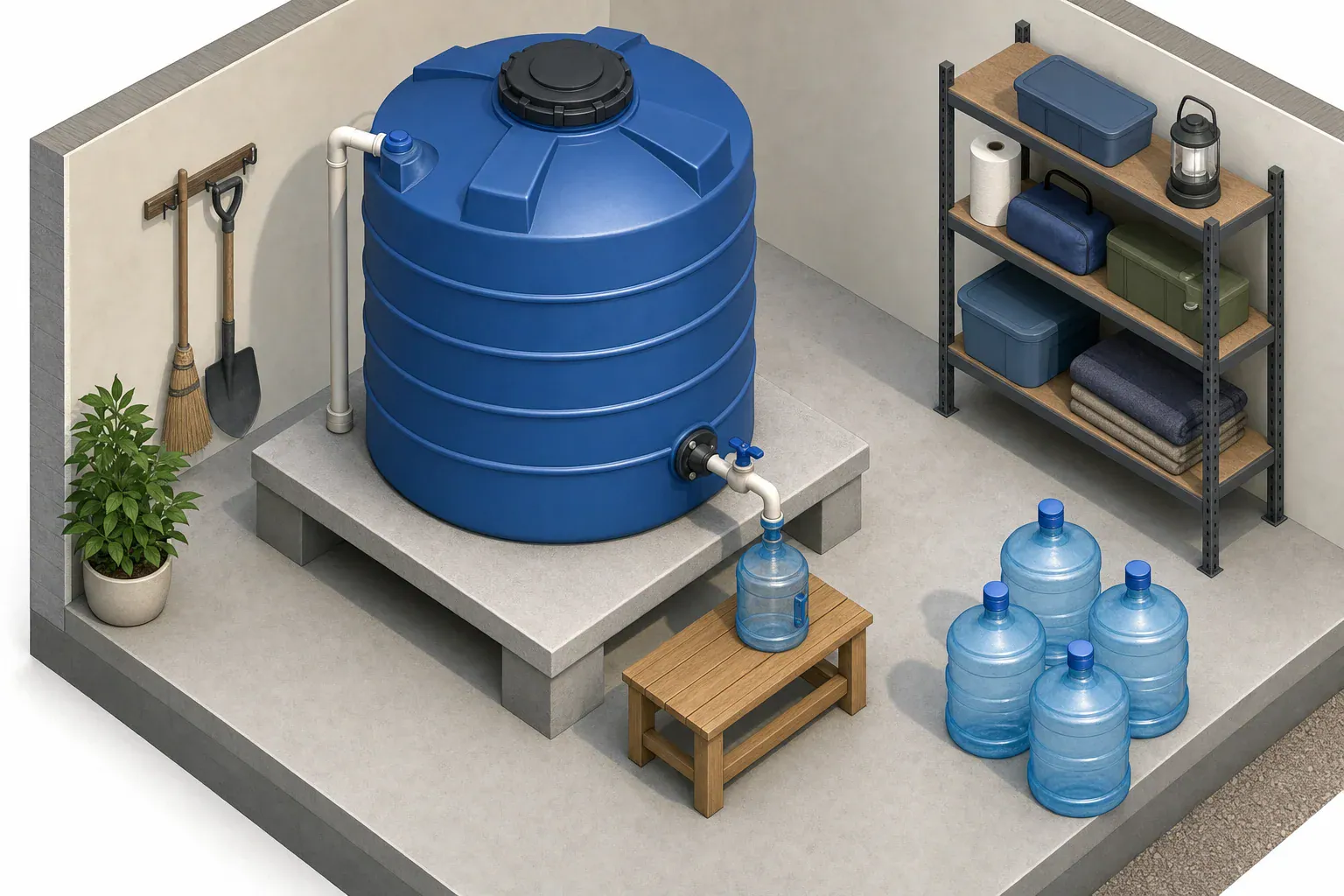
Quick answer: Potable water tanks can work well for sheltering at home when you can store the required usable volume on a fully supported level base, access every fitting for filling and cleaning, and dispense water without utility power. If any of those points is uncertain, portable jugs or a hybrid setup may be the better choice.
Are potable water tanks practical for your household?
A stationary potable water tank is a reasonable choice only if you can confirm all five points before buying it:
- Usable capacity: The water you can actually withdraw meets your household target. Nominal tank volume alone is not enough.
- Full support: A level location and its underlying structure can carry the tank, water, fittings, stand, and other equipment.
- Working access: The tank can be delivered, filled, inspected, drained, and cleaned in place.
- Outage dispensing: You can withdraw water when household power and water pressure are unavailable.
- Approved installation: The exact model is documented for potable-water storage and its intended above-ground or below-ground use, and the installation is accepted under applicable local rules.
If one or more points remain uncertain, use portable jugs or combine a smaller stationary reserve with jugs. Jugs provide movable water and reduce dependence on one tank, outlet, or pump.
Potable water tanks versus portable jugs
Tanks consolidate a large shelter-in-place supply, but they commit the household to one location and one dispensing system. Jugs take more individual handling but are easier to move, rotate, and divide among several locations.
| Decision point | Stationary tank | Portable jugs |
|---|---|---|
| Evacuation | Poor fit because a filled tank cannot normally be moved | Individual containers can be carried or loaded |
| Large shelter-in-place target | Consolidates water in one vessel | Requires more containers and storage positions |
| Location flexibility | Needs a committed, supported site | Can be redistributed more easily |
| Outage dispensing | Needs gravity clearance, a compatible manual pump, or dependable backup power | Can usually be poured or fitted with a small dispenser |
| Rotation | Needs a planned draining and refilling workflow | Containers can be rotated separately |
| Leak resilience | One failure may affect much of the reserve | Water is divided among containers |
A hybrid arrangement can cover both needs: a tank for sheltering at home and smaller containers for evacuation, bedside access, or carrying water to another room.
Size the tank by usable gallons
The CDC recommends storing at least 1 gallon per person per day for three days and trying for a two-week supply when possible. CDC also notes that more water may be needed in hot climates and for pregnancy, illness, or pets.
Use that amount as a preparedness baseline rather than a promise that it will cover normal cooking, bathing, laundry, or specialized medical needs. Write down additional household needs separately.
Baseline calculation: people × days × 1 gallon
Hypothetical four-person example
- Four people × 14 days × 1 gallon = 56 usable gallons.
- Using the USGS figure of about 8.33 pounds per U.S. gallon, the water alone weighs about 466 pounds.
- A nominal 55-gallon tank is already 1 gallon short, before considering water below the outlet, incomplete drainage, or spills.
- The required nominal tank size remains unknown until the manufacturer confirms usable drawdown for the exact model and installation.
Add the empty tank, fittings, valves, pump, platform, and any enclosure when evaluating the installed load. Do not assume an ordinary shelf, deck, or upper floor can carry it. When the supporting capacity is not documented or obvious, seek advice from an appropriately qualified structural professional.
What makes a tank location practical?
A tank location must work for the whole service cycle, not merely fit the tank’s outside dimensions.
- Base and support: Check the exact manual for the required foundation. Some vertical tanks require a smooth, level base supporting the entire bottom.
- Delivery route: Measure doors, gates, stairs, corners, ceiling height, and the space needed to turn the tank into position.
- Service clearance: Leave room to reach the fill opening, lid or manway, vent, outlet, drain, and fittings without climbing onto an unstable object.
- Drainage: Decide where a full tank can be drained without flooding the building, undermining its base, or sending water toward electrical equipment.
- Environment: Check the manual and local requirements for sunlight, heat, freezing, flood exposure, wind, and seismic anchorage.
- Contamination control: Keep stored water away from gasoline, pesticides, and similar chemicals. Protect openings from dirt, pests, and accidental access.
Above-ground and below-ground tanks are not interchangeable. For example, Norwesco’s above-ground tank guidance says its above-ground models cannot be buried or pressurized and require full bottom support. Those requirements apply to that manufacturer’s products; use the manual for the exact tank under consideration.
If the tank will connect to household plumbing, ask the local building or plumbing authority about permits, backflow protection, overflow, drainage, and other applicable rules. Use a licensed plumber or other qualified professional when code compliance or contamination protection is uncertain.
Plan filling and dispensing before purchase
The outlet, pump, and transfer containers determine whether stored water is useful during an outage.
- Choose the fill method. Confirm that the opening and hose or transfer equipment can be kept clean. A permanent plumbing connection may trigger local plumbing and backflow requirements.
- Confirm venting and overflow needs. Follow the exact manual. Do not seal or pressurize a tank unless the manufacturer specifically approves that use.
- Check gravity clearance. A low outlet may be unusable if there is no room beneath it for a clean container. Raising a tank can add structural and stability concerns.
- Select an outage method. Options may include a gravity valve, a compatible manual pump, or an electric pump with an appropriate backup supply. Do not assume a standard electric pump will work when grid power is out.
- Support the fittings. Heavy valves, rigid piping, and pump movement can load a tank wall. Follow model-specific instructions for flexible connections and separate support. Norwesco, for example, specifies flexible connections between its fitting and pump and separate support for heavy valves and fittings.
- Keep portable containers available. Clean, food-grade containers let household members carry water from the tank to where it is needed.
Before committing to a model, trace the full path from filling to final use. Include how you will open the valve, place a container, control the flow, and close the system in darkness or without normal utilities.
Rotation, inspection, and cleaning
Date the fill and maintain a written rotation record. CDC advises replacing home-filled stored water every six months and keeping it out of direct sunlight, preferably in a cool location. Tank material, source-water conditions, and manufacturer procedures still matter.
Between rotations, inspect accessible areas for leaks, damaged lids, loose fittings, blocked vents, contamination, and changes in the water. If water may be unsafe, follow current instructions from local health or water authorities rather than relying on appearance or taste.
Use the exact tank manufacturer’s cleaning and disinfection procedure. CDC’s method for small containers assumes the closed container can be shaken to wet every surface, so it should not automatically be scaled up for a stationary tank. Manufacturer guidance may require a different process, testing, or professional service.
Do not enter a tank to clean it. Snyder’s potable-water tank cleaning guidance treats tank entry as confined-space work. Arrange qualified service if cleaning cannot be completed safely from outside.
Pre-purchase checklist
- Exact-model documentation approving potable-water storage
- Nominal capacity and confirmed usable drawdown
- Empty weight, water weight, and total installed load
- Documented capacity of the supporting structure or foundation
- Tank dimensions, delivery route, and service clearances
- Approved above-ground or below-ground installation
- Required base, anchorage, and environmental protection
- Accessible fill opening and secure lid or manway
- Required vent, overflow, outlet, and lowest-point drain
- Gravity clearance, compatible manual pump, or workable backup power
- Flexible connections and separate support for heavy fittings where required
- A safe place to discharge water during draining and rotation
- Cleaning access that does not require entering the tank
- Local permit, plumbing, backflow, and drainage requirements
- Portable food-grade containers for carrying and backup storage
Do not purchase until unresolved items are answered in writing by the manufacturer, local authority, or an appropriately qualified professional. A smaller, simpler storage system that can be supported, maintained, and used during an outage is more practical than a larger tank with uncertain access or installation requirements.
Frequently asked questions
Can a potable water tank be connected to household plumbing?
It may be possible, but the connection can create local plumbing, backflow, overflow, drainage, and permit requirements. Confirm the exact tank’s approved use and ask the local authority having jurisdiction what applies before making a permanent connection.
How often should emergency tank water be replaced?
CDC advises replacing home-filled stored water every six months. For a stationary tank, also follow the tank manufacturer’s instructions and consider the source water and condition of the system. Keep a written fill and inspection record.
Can I use an electric pump during a blackout?
Only if the pump and its backup power arrangement will operate together during the outage. Verify that plan before purchase. A gravity outlet or compatible manual pump may provide a simpler no-power dispensing option when the installation allows it.
- Simple checklists and realistic planning
- Water, power, lighting, and pantry basics
- Family plans (kids, pets, seniors) and seasonal prep
Affiliate disclosure
As an Amazon Associate, we earn from qualifying purchases. Some links on this site may be affiliate links. If you buy through these links, we may earn a small commission at no extra cost to you. This helps support our content. Learn more.