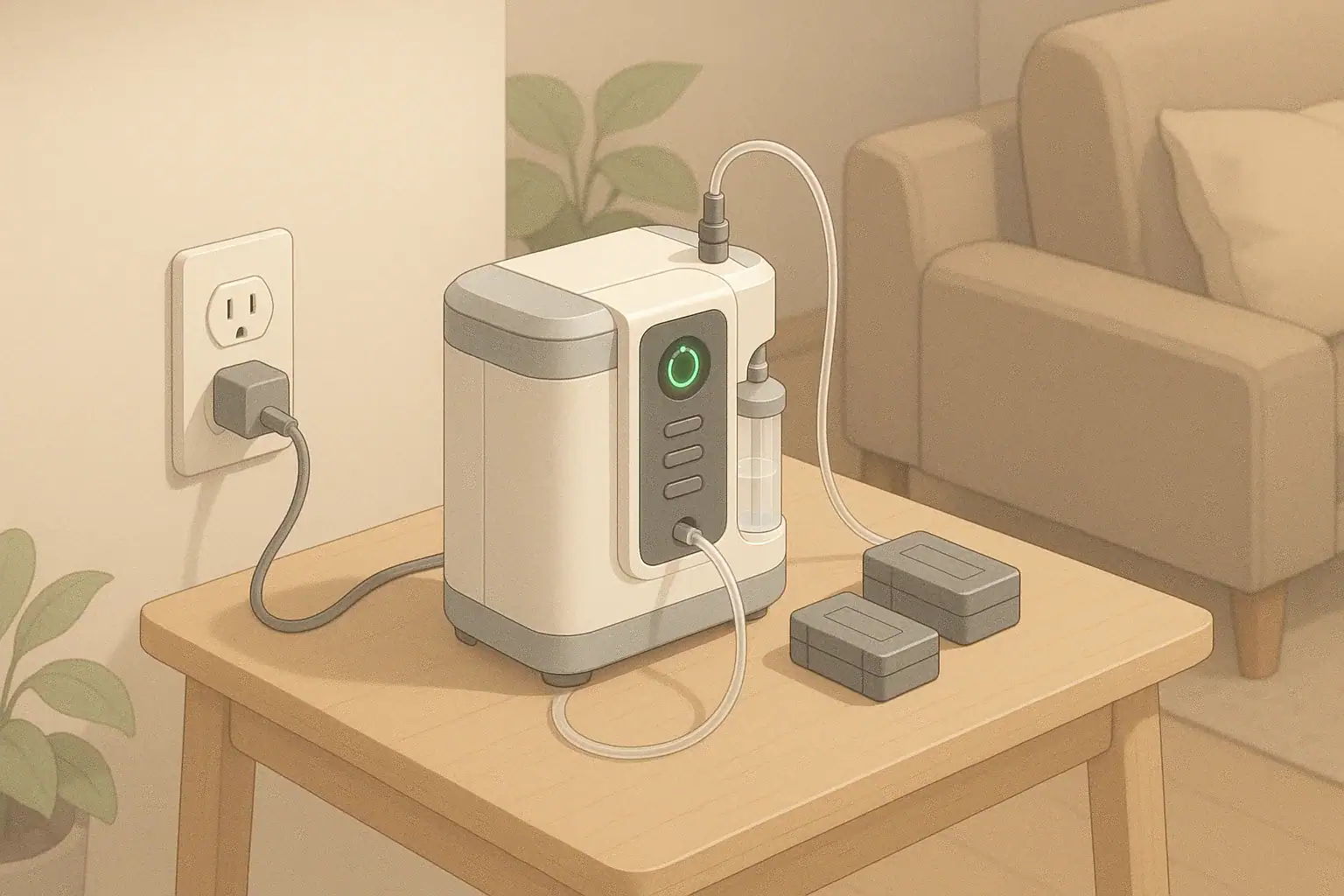
Why you need a backup plan for your portable oxygen concentrator
If you rely on a portable oxygen concentrator (POC), a simple power outage or dead battery can quickly turn into an emergency. A backup plan is about buying time and options: enough battery power, clear charging methods, and people you can call if something fails.
Your main goals are:
- Know exactly how long your POC can run on battery at your usual settings.
- Have enough charged batteries or backup oxygen to cover likely outages in your area.
- Have at least two ways to charge your device.
- Have a short list of contacts and steps to follow if power or equipment fails.
Always follow your oxygen provider’s and manufacturer’s instructions first. If anything in this guide conflicts with their directions, their directions win.
Understand your oxygen and power needs
Start by writing down the basics for your specific device and prescription. Keep this sheet with your POC and in your go-bag.
- Device make and model (from the label or manual).
- Prescribed oxygen flow (for example, pulse setting 2, or continuous 2 L/min).
- Typical battery life at your setting (from your manual or oxygen provider).
- Number of batteries you have and their sizes (standard vs extended).
- All power cords you own: AC (wall), DC (car), external chargers.
Ask your oxygen supplier or clinician to help you estimate how long your current setup will last in a power outage, and what backup they recommend for your medical needs. People who need continuous oxygen or higher flow usually need more robust backup than people on low pulse settings.
Plan your POC battery backup
Battery backup is your first line of defense when power goes out or you are away from an outlet.
How many batteries should you have?
There is no single right number, because it depends on your health, your device, and how often your power goes out. As a starting point, talk with your clinician and oxygen supplier about:
- Minimum safe time you should be able to stay on your POC without wall power (for example, 8–24 hours).
- Battery life at your usual setting (for example, 3 hours per battery).
- How quickly you can get help if power is out (family, neighbors, emergency services).
Use those answers to decide how many batteries you reasonably need. Some people may only need one spare; others may need several plus a backup oxygen source.
Use and store batteries safely
- Follow the manufacturer’s instructions for charging and storage.
- Store batteries in a cool, dry place away from heat sources and direct sun.
- Do not use damaged, swollen, or corroded batteries; contact your supplier if you notice problems.
- Do not carry loose batteries with metal objects (keys, coins) that could short the contacts.
- Label batteries with the purchase date and rotate their use so one battery is not always the oldest.
If your device uses an external battery charger, keep it plugged into a surge-protected outlet so you always have at least one battery topped up.
Charging options during an outage
Most POCs can run and charge from wall outlets, and many can also run from a vehicle outlet. Some can be powered from certain backup power systems if they meet the device’s requirements. Always confirm compatibility with your oxygen provider or the device manufacturer before trying a new power source.
Wall power (AC)
- Use only the power supply that came with your POC or a manufacturer-approved replacement.
- Plug into a grounded outlet away from water and tripping hazards.
- Consider a simple surge protector to help protect your device from power spikes.
Vehicle power (DC)
Many POCs can plug into a vehicle’s 12V outlet using a compatible DC power cord.
- Confirm in your manual that your POC is approved for vehicle use and which cord is required.
- Run the vehicle engine as directed in the vehicle manual to avoid draining the battery.
- Secure the POC so it will not tip or block airbags, pedals, or seat belts.
- Never run a vehicle inside a garage or enclosed space because of carbon monoxide risk. For safety guidance, see the CDC information on carbon monoxide poisoning.
Backup power systems
Some people consider using a home backup power system (such as a battery power station or generator) to run or charge a POC. These options can be helpful but must be used carefully.
- Check your POC’s power requirements in the manual (voltage, wattage, and type of plug).
- Confirm with your oxygen supplier or manufacturer before using any backup power system.
- If you use a portable generator, operate it outdoors and away from windows and doors to avoid carbon monoxide. The U.S. Consumer Product Safety Commission guidance on portable generator safety explains safe placement.
- Follow all instructions from the generator or power station manufacturer and your local building or fire codes.
Backup power systems can fail or run out of fuel, so they should be part of your plan, not your only plan.
Backup oxygen options beyond your POC
Depending on your health needs, your clinician and oxygen supplier may recommend additional backup oxygen sources in case your POC or power fails.
Common options they may discuss include:
- Home oxygen concentrator (larger plug-in unit) with its own backup plan.
- Compressed oxygen cylinders (tanks) with a regulator and clear instructions.
- Liquid oxygen systems where available.
Ask your clinician and supplier:
- What type and size of backup oxygen is appropriate for you.
- How long each backup source will last at your prescribed flow.
- How to switch safely between your POC and backup oxygen.
- How and when to reorder supplies so you do not run low.
Never change your oxygen flow or equipment setup on your own without medical guidance unless you are following a written plan from your clinician.
Essential contacts and information sheet
In an emergency, it is much easier to act if everything you need is written down and easy to find. Create a one-page sheet and keep copies:
- On the refrigerator or a visible wall.
- In your go-bag.
- With a trusted family member or neighbor.
Include:
- Your name, address, and date of birth.
- Diagnosis and oxygen prescription (for example, “Uses portable oxygen concentrator, pulse setting 2 at rest, 3 with activity”).
- Device details: make, model, serial number if available.
- Oxygen supplier: company name, 24-hour phone number, account number if used.
- Clinician contact: primary doctor or specialist, office and after-hours numbers.
- Emergency contacts: family, neighbors, or caregivers who can help move equipment, drive you, or check on you.
- Local emergency number: In the U.S., 911 for immediate emergencies.
- Short instructions for responders: where your equipment and backup oxygen are stored, and any mobility or communication needs.
If you live in the U.S., ask your local emergency management office or utility company if they have a registry or program for people who depend on electricity for medical equipment. Some areas offer priority notifications or guidance for outages. The general Ready.gov guidance for people with access and functional needs has questions to consider when planning.
Daily habits that keep you ready
Small routines make your backup plan much more reliable.
- Charge every day: Plug in your POC or spare battery whenever you are sitting or sleeping so you start each day with as much charge as possible.
- Check battery levels: Make it a habit to look at the battery indicator before leaving home.
- Keep cords together: Store your AC and DC power cords in a labeled pouch so they are easy to grab.
- Test your backup: Once or twice a year, review your plan, check batteries, and confirm phone numbers.
- Watch for recalls or updates: If you receive notices from your oxygen supplier or manufacturer, read and save them.
When to seek urgent help
Call 911 or your local emergency number right away if:
- You feel severe shortness of breath, chest pain, confusion, or bluish lips or fingers.
- Your oxygen equipment fails and you do not have a safe backup source.
- Smoke, fire, flooding, or another hazard makes it unsafe to stay where you are.
For non-emergency questions about your oxygen settings or equipment, contact your clinician or oxygen supplier. They know your medical history and device details and can give you specific instructions that this general guide cannot.
Frequently asked questions
How long should my portable oxygen concentrator backup last?
It depends on your health needs, your device, and local conditions. Some people plan for several hours; others plan for a full day or more. Ask your clinician and oxygen supplier what minimum backup time is appropriate for you, then choose batteries and backup oxygen to match that goal as closely as you reasonably can.
Can I use a portable power station to run my POC?
Sometimes, but only if the power station meets your POC’s electrical requirements and the manufacturer or your oxygen supplier confirms it is appropriate. Check your POC manual for voltage and wattage needs, and verify compatibility before you rely on any power station in an emergency.
Is it safe to sleep while my POC is on battery power?
Many people do, but safety depends on your specific device, settings, and health. Ask your clinician whether your POC and backup plan are suitable for overnight use, and how much battery time you should have available before going to sleep.
What should I tell my utility company about my oxygen use?
Ask your utility company if they have a medical needs or life-support equipment program and what documentation they require. These programs do not guarantee power, but they may offer outage notifications or planning advice. Your clinician or oxygen supplier may be able to provide the information the utility requests.
- Simple checklists and realistic planning
- Water, power, lighting, and pantry basics
- Family plans (kids, pets, seniors) and seasonal prep
Affiliate disclosure
As an Amazon Associate, we earn from qualifying purchases. Some links on this site may be affiliate links. If you buy through these links, we may earn a small commission at no extra cost to you. This helps support our content. Learn more.