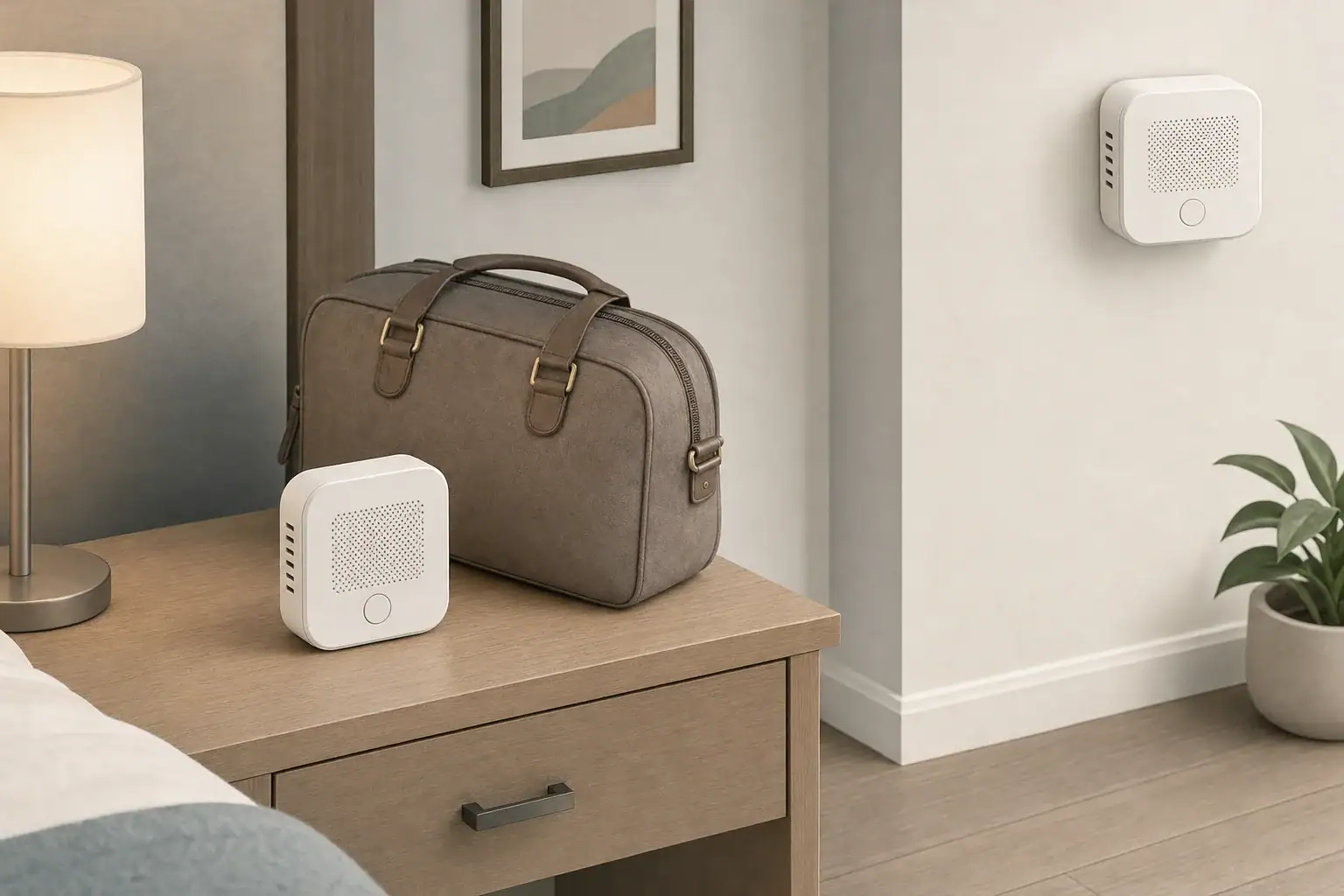
Quick answer: A portable carbon monoxide detector can add a standalone warning in approved temporary indoor lodging or an occupied room during an outage. It is supplemental: it does not replace household CO alarms, provide whole-home coverage, or make indoor use of generators, grills, stoves, or fuel-burning heaters safe.
Portable carbon monoxide detector: the useful role and the limit
A portable carbon monoxide detector may be useful as an additional alarm when you are away from home, staying in temporary lodging, or occupying an approved indoor space during an outage. Its value depends on the exact model being listed for that setting, having working power, and being used as its manual directs.
It is not a replacement for a home alarm system. The U.S. Consumer Product Safety Commission (CPSC) recommends CO alarms on every level of a home and outside sleeping areas, with battery power or battery backup. CPSC also describes an alarm as added protection, not a substitute for safe appliance use and maintenance.
How portable units differ from installed alarms
“Portable” is a retail description, not one universal safety classification. It can describe a battery-powered residential alarm that is easy to carry, a travel-specific alarm, a plug-in model, or a handheld CO meter. Small size alone does not show where a device may safely be used.
A household CO alarm is intended to provide ongoing protection in designated home locations. Depending on the model, alarms may be hardwired, battery powered, or interconnected so an alarm in one area can warn people elsewhere. A portable unit is generally a standalone supplement for one occupied area; it does not create whole-home coverage or replace alarms required by local rules, a lease, or a building safety plan.
A handheld meter or monitor is also different from a life-safety alarm. Do not assume a display, app, sensor claim, or marketplace label means the complete product is listed as a CO alarm. Check the exact model’s marking, approved application, and manual.
Comparison: fixed, plug-in, and portable CO alarms
| Type | Typical role | Power | Mounting or placement | Alerts | Main limitation |
|---|---|---|---|---|---|
| Fixed household alarm | Baseline home coverage | Hardwired, sealed battery, or replaceable battery; some hardwired models include backup power | Installed where the manual and applicable local requirements allow | Audible CO alarm; some models can interconnect or include voice or visual features | Stays location-specific and is not necessarily intended for travel |
| Plug-in alarm with battery backup | Home use in a room with a suitable outlet | AC power plus an operational backup battery, if the model provides one | Uses an approved receptacle and must still meet the manual’s placement directions | Audible alarm plus model-specific status, fault, and battery indications | An outlet may not be in an approved location, and the backup battery must remain functional |
| Portable or travel unit | Supplemental warning in approved temporary indoor lodging or another occupied space | Battery, AC, or dual power depending on the model | Tabletop, wall, or outlet placement only when the manual permits it | Usually standalone; displays, memory, voice, and visual signals vary | Does not provide required whole-home coverage and may exclude vehicles, RVs, boats, tents, garages, or outdoor conditions |
The categories can overlap. A battery-powered residential alarm may be easy to pack, yet still be approved only for conditioned indoor residential use.
What to verify before buying or carrying one
- Complete-product listing: Look for a certification or listing mark on the complete model. CPSC recommends CO alarms that meet the current UL 2034 standard. Do not rely on a claim about a sensor component alone.
- Approved application: Read the label and manual for the intended setting. Residential, travel, RV, marine, vehicle, and outdoor applications are not interchangeable.
- Power during an outage: Identify whether the unit uses replaceable batteries, a sealed battery, AC power with backup, or another arrangement. Use only the battery type and power method specified by the manufacturer.
- Alerts people can notice: Confirm that it has an audible CO alarm. Consider visual, voice, or compatible accessibility features if they are important for the people using the space.
- Trouble signals: Learn the difference between a CO alarm and low-battery, fault, or end-of-life indications. These patterns vary by model.
- Replacement information: Keep the exact manual and follow its replacement date or end-of-life instructions.
Do not make a decision from a marketplace title alone. Match the model number on the device to its manual and listing information. If the intended use is unclear, choose a device specifically listed for that environment or ask the manufacturer before relying on it.
Where a portable alarm may be carried and positioned
A portable alarm may be carried to a hotel room, vacation rental, evacuation lodging, or other occupied indoor space only if its listing and instructions allow that environment. Approval for one indoor residential setting does not automatically include a parked or moving vehicle, RV, boat, tent, garage, porch, campsite, or outdoor area.
- Follow the exact manual’s wall, tabletop, or outlet-placement directions.
- Keep the device and its vents clear of luggage, bedding, curtains, furniture, and other obstructions.
- Use a permitted location where sleeping occupants can hear its alarm.
- Observe the stated temperature, humidity, airflow, and weather-exposure limits.
- Follow transport instructions, then install or activate the unit and use its test feature as directed after arrival.
For example, a Kidde residential CO alarm manual gives specific wall and tabletop directions and excludes weather exposure, garages, obstructed positions, and conditions outside its stated operating range. Those are instructions for models covered by that manual, not universal portable-alarm rules. They show why the exact manual matters.
Outages and fuel-burning equipment
A portable alarm can be an extra warning layer in an approved occupied space during an outage. It does not make an unsafe combustion practice safe. Never run a portable generator indoors or in a garage, basement, shed, or other enclosed or partially enclosed space. The U.S. Fire Administration says to use portable generators outdoors and away from doors, windows, and vents. See our generator safety basics for additional outage-planning context.
Do not use a grill, camp stove, or another device intended for outdoor use indoors. Use heaters and household appliances only as their instructions allow. A CO alarm is backup protection; it is not permission to reduce safe separation, ignore ventilation requirements, or operate fuel-burning equipment in prohibited locations.
What to do if a CO alarm sounds
Treat a CO alarm as an emergency. Move everyone outside to fresh air, then call 911, the fire department, or the local emergency number from outside. Do not stay inside to investigate the source, and do not reenter until emergency responders say it is safe. This follows the emergency direction in CPSC’s CO guidance.
If the signal is identified as low battery, fault, or end of life rather than the CO alarm pattern, follow the exact manual promptly and restore protection. If you cannot identify the signal, or anyone may have been exposed to CO, leave the area and contact emergency services.
Frequently asked questions
Can a portable carbon monoxide detector replace the alarms in my home?
No. A portable unit is a supplement, not a replacement for home CO alarm coverage. CPSC recommends alarms on every home level and outside sleeping areas. Local building rules, landlords, and building safety plans may set additional requirements.
Can I use a portable CO alarm in an RV, vehicle, tent, or boat?
Only if the exact model is listed and instructed for that application. Many residential and travel-oriented CO alarms exclude RVs, boats, vehicles, weather exposure, or unconditioned spaces. Check the device label and manual before using it there.
Does a digital CO display make a device a life-safety alarm?
No. A display can be a useful feature, but it does not establish that the complete product is listed as a life-safety CO alarm. Verify the model’s certification or listing, intended application, alarm functions, and instructions.
- Simple checklists and realistic planning
- Water, power, lighting, and pantry basics
- Family plans (kids, pets, seniors) and seasonal prep
Affiliate disclosure
As an Amazon Associate, we earn from qualifying purchases. Some links on this site may be affiliate links. If you buy through these links, we may earn a small commission at no extra cost to you. This helps support our content. Learn more.