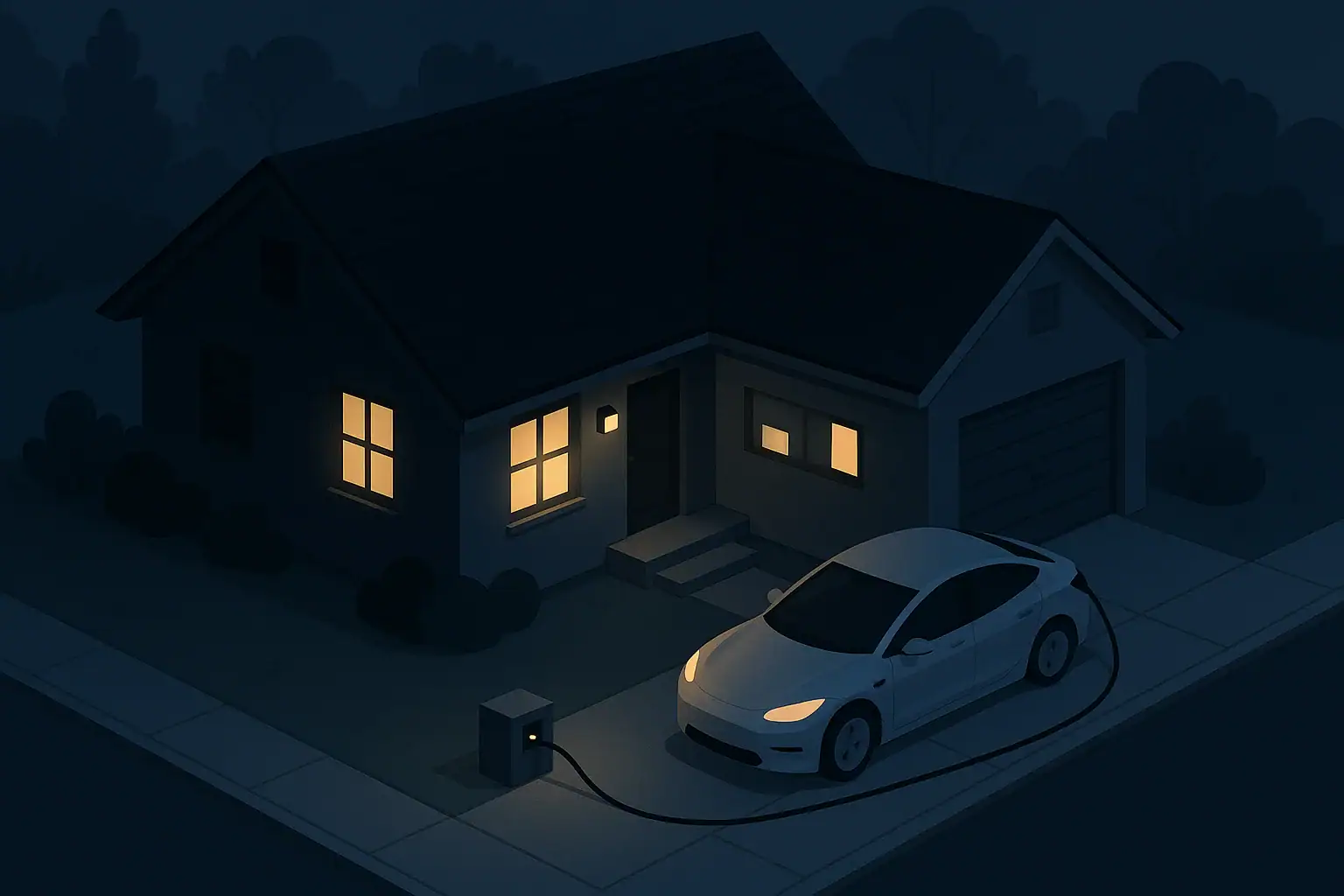
Can an electric vehicle really power your home?
Many newer electric vehicles can share power back out, either through a built-in outlet (often called vehicle-to-load, or V2L) or through special equipment that connects the car to your home (vehicle-to-home, or V2H). In a short outage, an EV can often keep essentials running: a fridge, some lights, phone charging, a modem or router, and maybe a small space heater or window A/C if you manage loads carefully.
However, an EV is not a magic whole-house generator. Most homes use far more power than a single vehicle can safely or practically supply at once. The realistic goal is to keep critical loads going for hours or days, not to live as if nothing happened.
This guide explains the differences between V2L and V2H, what they can usually power, how to think about run time, and the key safety limits to respect during an outage.
Key terms: V2L, V2H, and V2G in plain language
Manufacturers and utilities use different labels, but most EV backup setups fall into three buckets:
- V2L (Vehicle-to-Load): The vehicle has one or more built-in outlets (often 120 V and/or 240 V) or a special adapter that gives you standard household plugs. You run extension cords from the car to individual devices. The car is not hardwired into your home panel.
- V2H (Vehicle-to-Home): The EV connects to a transfer switch or special bidirectional charger that feeds selected circuits in your home. When the grid is down, your home (or a backup subpanel) is powered by the car instead of the utility.
- V2G (Vehicle-to-Grid): The EV sends power back to the utility grid during normal times. This is usually part of a utility program and is less about emergency backup and more about grid support.
For household readiness, V2L and V2H are the most relevant. V2L is simpler and portable; V2H is more convenient but requires professional installation and compatible equipment.
What an EV can realistically power in an outage
Every EV and home is different, but you can think in terms of three tiers of loads.
Tier 1: Essentials most EVs with V2L or V2H can often handle
These are the first things to prioritize in a short outage:
- Refrigerator or freezer (typically 100–800 watts while running, with short higher surges when the compressor starts)
- Phone, tablet, and laptop charging (usually under 100 watts total)
- Modem, router, and a small TV or radio for news and communication
- LED lighting in a few key rooms (very efficient, often 5–10 watts per bulb)
- Small fans for comfort and air circulation
Most V2L systems that provide around 1.5–3 kW of continuous power can run several of these at once, as long as you avoid turning on multiple big loads at the same time.
Tier 2: Bigger loads that may be possible with careful planning
Depending on your EV’s output and your home wiring, you may be able to run some of these, but usually not all at once:
- Microwave (often 800–1,500 watts while running)
- Coffee maker, toaster, or electric kettle (often 800–1,500 watts)
- Small portable space heater (often 750–1,500 watts; use cautiously and never leave unattended)
- Window A/C unit (varies widely; many are 500–1,500 watts plus startup surge)
- Sump pump or well pump (can have high startup surges; check nameplate ratings and consult a qualified electrician)
These loads can quickly use up your available power and battery capacity. In an emergency, it often makes sense to run them only as needed and one at a time.
Tier 3: Loads that are usually unrealistic or risky
Even with V2H, many whole-house loads are not practical or may require more power than your EV system can safely provide:
- Central air conditioning for the whole house
- Electric resistance water heaters
- Electric ranges and ovens running at full power
- Large electric dryers
- Whole-house electric heating (baseboard, large electric furnaces)
Some advanced V2H setups may be able to support certain large loads, but that requires careful design and professional installation. For most households, the realistic plan is to shut off or avoid these loads during an outage and focus on essentials.
Estimating how long your EV can power essentials
Run time depends on three main factors:
- Your EV battery size (measured in kilowatt-hours, kWh)
- The power draw of what you are running (watts or kilowatts)
- How low you are willing to let the EV battery go before you stop using it for backup
A rough way to think about it:
- Convert your EV battery size to usable energy (for example, you might choose to use only half the battery so you can still drive if needed).
- Estimate your average load in kilowatts (kW). For example, 400 watts of mixed loads is 0.4 kW.
- Divide usable kWh by average kW to get hours of run time.
Example: If you are comfortable using 30 kWh of your battery and you keep your average load around 0.5 kW (500 watts), you might get roughly 60 hours of runtime. In real life, efficiency losses, temperature, and changing loads will affect this, so treat it as a ballpark, not a promise.
To stretch run time:
- Turn big loads on only when needed (for example, run the microwave briefly, then turn it off).
- Let the fridge cycle normally but avoid opening it often.
- Use LED lights and low-power devices whenever possible.
- Decide in advance how much battery you want to reserve for driving in an emergency.
Using V2L safely with extension cords
V2L is attractive because you can often use it with just an adapter and extension cords, but it still involves household electricity. Misuse can cause shock, burns, or fire. The U.S. Consumer Product Safety Commission has general guidance on portable generator and extension cord safety, and many of the same principles apply here.
Basic safety points:
- Never backfeed your home by plugging an EV outlet into a household wall receptacle. This is dangerous for you and for utility workers and is typically a code violation.
- Use heavy-duty, outdoor-rated extension cords for outdoor use and higher loads. Check the cord’s rating and keep total load below that rating.
- Keep cords fully uncoiled and out of standing water to reduce overheating and shock risk.
- Use grounded (three-prong) cords and outlets when your devices require grounding.
- Do not exceed the EV’s outlet rating (for example, a 15-amp, 120 V outlet is typically limited to about 1,800 watts, and continuous loads should be lower).
For critical medical equipment or unusual loads, ask your equipment provider or a licensed electrician how best to power them safely during an outage.
V2H: When your EV is wired into the house
V2H systems are more complex but more convenient in an outage. They usually involve a bidirectional charger or inverter and a transfer switch or dedicated backup panel. When the grid goes down, the system isolates your home from the grid and draws power from the EV instead.
Important considerations:
- Professional installation is essential. This work must comply with local electrical codes and utility requirements. Improper wiring can cause fire, shock, or damage to your EV and home.
- Use a transfer mechanism that isolates your home from the grid. This protects line workers and prevents backfeeding. The U.S. Department of Energy and Ready.gov guidance on power outages both emphasize avoiding backfeeding when using backup power.
- Plan a backup subpanel. Many systems power only a set of critical circuits (fridge, a few outlets, some lights, maybe a small A/C or heat source) instead of the whole house.
- Understand your system’s limits. Your installer should explain the maximum continuous and surge power, which circuits are backed up, and any loads you must keep off during an outage.
Because V2H is still a developing area, local codes, utility rules, and available equipment can change. Before investing, check with your utility and a licensed electrician who is familiar with EV charging and backup systems.
Planning realistic emergency loads
A little planning before an outage makes using your EV as backup power much less stressful.
1. List and prioritize your critical loads
Walk through your home and list what you truly need in a short outage:
- Food safety (fridge, freezer)
- Communication (phones, modem/router, radio)
- Lighting in a few key areas
- Medical or accessibility equipment that must stay powered
- Heating or cooling for safety, especially for infants, older adults, or people with health conditions
Then add “nice to have” items (TV, extra lights, small appliances) that you can turn off if needed.
2. Check wattage and label your plan
Look at the labels on your appliances and devices to find their wattage or amperage. For items with motors (fridges, pumps), remember that startup surges can be higher than running watts.
Write down:
- Which items you plan to power from the EV
- Their approximate wattage
- Which outlet or circuit you will use
Keep this list with your outage kit so you are not guessing under stress.
3. Decide how much battery to reserve
Think about whether you might need to drive during an extended outage (for example, to reach work, a shelter, or medical care). Decide in advance what state of charge you want to keep as a minimum and stop using the EV for backup when you reach that point.
4. Practice on a calm day
When the weather is good and you have time, do a short test:
- Power a few planned loads from your EV for an hour or two.
- Check for warm cords, tripped breakers, or unexpected behavior.
- Note how quickly the battery percentage drops under your typical emergency load.
Stay within the manufacturer’s instructions for your vehicle and any adapters or inverters. If anything seems unsafe, stop and consult a qualified electrician.
Safety limits and when to get expert help
Using an EV as backup power can be safer than running a fuel generator indoors, but it still involves high energy levels and electrical risks. Keep these limits in mind:
- Follow your EV manufacturer’s instructions. Some vehicles are designed for V2L or V2H; others are not. Using unapproved adapters or methods can damage the vehicle or create hazards.
- Do not modify your electrical panel or wiring yourself. Any connection that feeds power into your home wiring should be designed and installed by a licensed electrician.
- Protect against carbon monoxide from other sources. If you also use fuel-burning heaters or generators, follow CDC guidance on carbon monoxide safety and keep them outside and away from windows and doors.
- Respect local authorities and utility rules. If your utility or local emergency management issues guidance during a disaster, follow their instructions even if it means changing how you use backup power.
If you rely on powered medical devices, talk with your healthcare provider and device supplier about backup options. They may recommend additional batteries, priority restoration programs, or alternate care locations beyond what an EV can provide.
Frequently asked questions
Can I plug my EV into a wall outlet to power the house?
No. Plugging an EV outlet into a household receptacle to “backfeed” the home is dangerous and typically violates electrical codes. It can energize wiring you think is off, damage equipment, and endanger utility workers. Use only properly installed transfer equipment or run individual devices from the EV with extension cords.
Is using my EV as backup power bad for the battery?
Battery impact depends on how the system is designed and how often you use it. Some vehicles and chargers are built with bidirectional use in mind. Others are not. Check your owner’s manual or contact the manufacturer for guidance on recommended use, limits, and any warranty implications.
Can my EV run my central air conditioner?
In many homes, central A/C requires more power than a typical V2L setup can provide and may exceed what some V2H systems are designed to handle. Even when technically possible, running central A/C can drain the EV battery quickly. For most households, it is more realistic to cool one room with a smaller unit or use fans and shading strategies during an outage.
Do I still need other backup options if I have an EV?
An EV can be a strong part of your backup plan, but it may not cover every situation. Long outages, very cold or hot weather, or mechanical issues with the car can all limit what you can do. Many households combine an EV with other measures such as stored water, nonperishable food, flashlights, battery-powered lanterns, and a plan for reaching shelters or community resources if needed.
- Simple checklists and realistic planning
- Water, power, lighting, and pantry basics
- Family plans (kids, pets, seniors) and seasonal prep
Affiliate disclosure
As an Amazon Associate, we earn from qualifying purchases. Some links on this site may be affiliate links. If you buy through these links, we may earn a small commission at no extra cost to you. This helps support our content. Learn more.