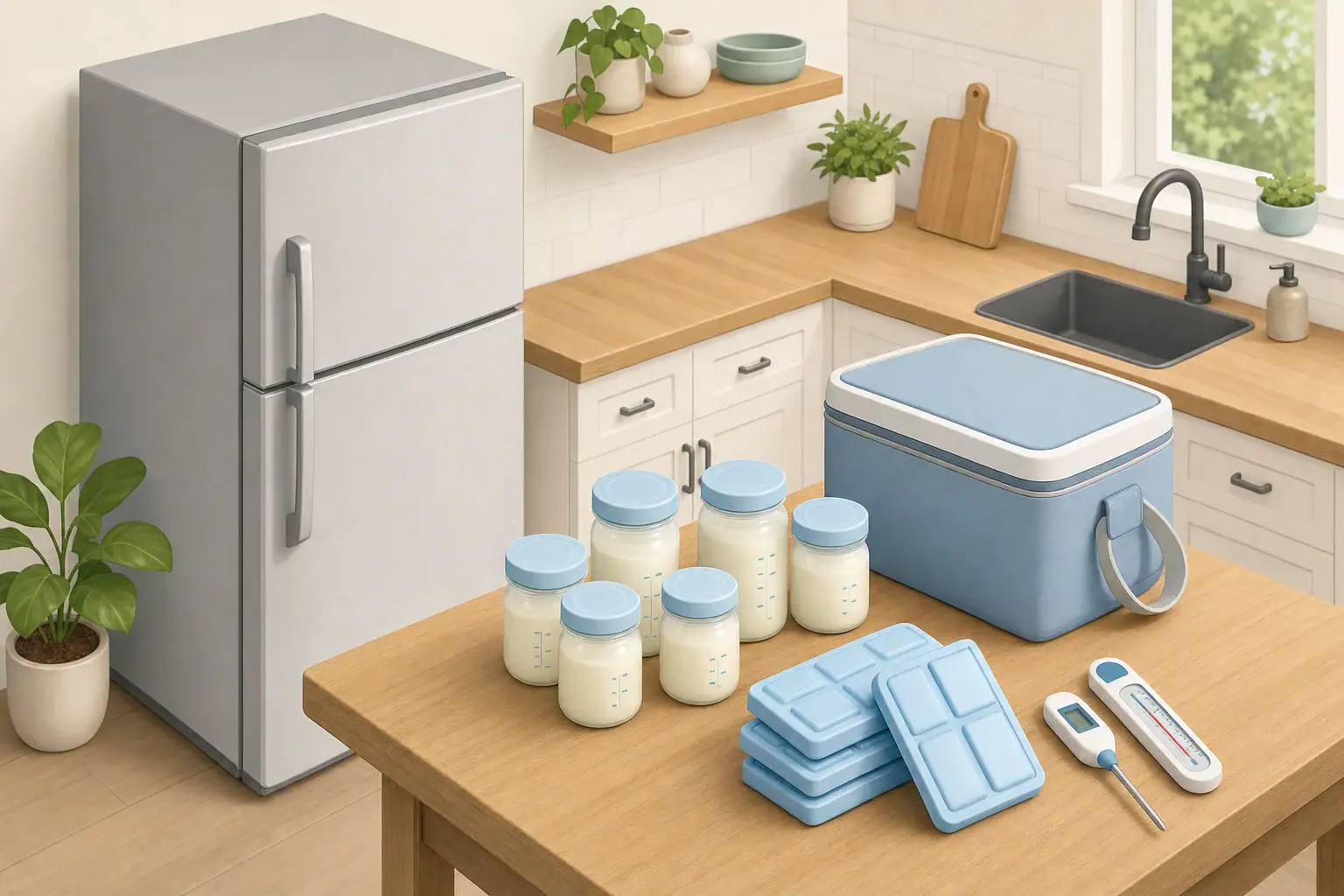
Quick answer: For breast milk during a power outage, keep refrigerator and freezer doors closed first. Stage a cooler, frozen packs, and thermometers. Move refrigerated milk only if continued storage at 40°F or below is needed. After power returns, assess each container by temperature, original storage age, thawing history, and ice crystals.
Breast milk during a power outage: four calm steps
- Stage: Gather a cooler, ice or frozen gel packs, thermometers, labels, and a marker.
- Wait: Keep refrigerator and freezer doors closed while the appliances remain the best available cold storage.
- Transfer only when needed: Move refrigerated milk when continued storage at 40°F or below is needed and the cooler can maintain that temperature.
- Assess: After power returns, evaluate each container using temperature records, its original storage age, thawing history, and visible ice crystals.
An outage is stressful, but you do not need to open appliances immediately. The familiar four-hour refrigerator and 24- or 48-hour freezer figures are planning estimates for closed appliances, not automatic discard deadlines for every container. Starting temperature, room temperature, appliance condition, fullness, and door openings all matter.
Prepare a breast-milk cooler kit
CDC emergency infant-feeding guidance recommends preparing extra ice, frozen water containers or gel packs, and freestanding appliance thermometers. CDC advises keeping a refrigerator or cooler used for breast milk at 40°F or below and a freezer at 0°F or below.
- An insulated cooler that fits the milk you may need to protect
- Frozen gel packs, frozen water containers, or ice
- Thermometers for the refrigerator, freezer, and cooler
- Milk containers marked with their original expression date
- A waterproof marker and a written outage log
- Clean feeding and milk-storage supplies
- A manual pump or a hand-expression plan if an electric pump is unavailable
Before an outage, read the manuals for your refrigerator, freezer, cooler, and thermometer. Some thermometers display only the current reading, while others store minimum and maximum temperatures. Appliance and cooler manuals may provide model-specific limits or operating instructions; do not assume every appliance or cooler holds temperature for the same length of time.
When to leave milk in place or move it
Start by keeping the doors closed. CDC says an unopened refrigerator generally keeps food cold for about four hours. A closed full freezer may hold its temperature for about 48 hours, compared with about 24 hours for a half-full freezer. These estimates help with planning; they are not a substitute for a thermometer reading.
If the outage is expected to continue beyond the refrigerator’s approximate cold-holding window, prepare the cooler before opening the refrigerator. The FDA’s power-outage guidance recommends having coolers and ice or frozen gel packs available for outages that last longer than four hours.
- Set up the cooler and thermometer first.
- Add enough ice or frozen packs to keep the cooler at 40°F or below.
- Make one quick, organized transfer of refrigerated milk.
- Keep each container’s original expression date visible.
- Record the outage start time, transfer time, and cooler readings.
CDC says freshly expressed milk can be kept in an insulated cooler with frozen ice packs for up to 24 hours. Moving milk that was already refrigerated does not create a new 24-hour storage period or reset its original expression date. Keep its original storage history in mind.
Do not move frozen milk immediately unless the destination can reliably keep it frozen. A closed freezer may protect frozen milk better than a cooler. Ordinary ice can keep a cooler cold, but it does not by itself guarantee freezer-level temperatures.
Monitor temperatures with minimal opening
- Write down when the outage began and when milk was transferred.
- Keep refrigerator, freezer, and cooler openings brief and infrequent.
- Check that the cooler remains at 40°F or below, adding ice or frozen packs as needed.
- Do not rely on a container feeling cool to judge its storage history.
- Do not use smell, taste, color, or appearance alone to decide whether milk is safe.
Ready.gov’s power-outage preparedness sheet also advises households to prepare ice and use thermometers in refrigerators and freezers. Its food-safety advice is general; for breast milk, follow CDC’s breast-milk-specific guidance.
Assess breast milk after power returns
| Milk condition | What to do | Source basis |
|---|---|---|
| Refrigerated milk remained at 40°F or below and is still within its original storage period | Continue refrigerated storage or use it. Keep the original expression date. | CDC temperature guidance and ordinary storage-history principles |
| Refrigerator remained closed during an outage of roughly four hours or less, but no temperature record is available | Check the appliance temperature when practical. The four-hour figure is an estimate, not proof of an individual container’s condition. | CDC closed-refrigerator estimate |
| Frozen milk still has visible ice crystals | CDC considers the milk still frozen. It may remain frozen or be refrozen. | CDC breast-milk emergency guidance |
| Milk is completely thawed but still cold, and the complete-thaw time is known | Do not refreeze it. Refrigerate it and use it within 24 hours from complete thawing, or discard it. | CDC breast-milk emergency guidance |
| Milk is completely thawed and the complete-thaw time is unknown | Do not refreeze it. Because the 24-hour clock cannot be established, take a conservative discard approach or contact the child’s clinician for individualized advice. | CDC does not provide an outage-specific formula for unknown history |
| Milk became warm or has an unknown time-and-temperature history | Do not taste-test it. CDC does not provide a precise salvage formula for this situation; a conservative discard decision avoids guessing. | Evidence limit; CDC temperature and storage guidance |
Inspect frozen containers individually. Containers in different parts of a freezer may thaw at different rates. For breast milk, use CDC’s visible-ice-crystal rule rather than applying general FDA food-refreezing guidance to breast milk.
When to ask for individualized help
A thermometer cannot reconstruct missing storage history, and there is no supported formula for adding together time in a refrigerator, cooler, and warmer conditions. If you cannot establish the milk’s temperature or thawing history, avoid trying to calculate a new allowance.
Ask the child’s clinician for individualized guidance for a premature infant or an infant with medical vulnerabilities. The clinician’s instructions should take priority over this general household plan.
Household outage checklist
- Refrigerator and freezer thermometers are installed and readable.
- A separate cooler thermometer is available.
- The cooler is clean, accessible, and large enough for the expected supply.
- Ice, frozen water containers, or gel packs are ready.
- Milk containers retain their original expression dates.
- A marker and outage log are stored with the cooler.
- Household members know who will make a planned transfer if needed.
- A manual pumping or hand-expression plan is available.
- Caregivers know that completely thawed milk must not be refrozen.
Frequently asked questions
Should I move frozen breast milk to a cooler as soon as the power goes out?
Not necessarily. Keep the freezer closed first. Move frozen milk only if you have a destination that can reliably keep it frozen; a closed freezer may protect it better than a cooler.
Can breast milk with ice crystals be refrozen?
Yes. CDC considers breast milk with visible ice crystals still frozen, so it may be refrozen or kept frozen.
Can I refreeze breast milk that has completely thawed but is still cold?
No. CDC advises against refreezing completely thawed breast milk. If the complete-thaw time is known, refrigerate it and use it within 24 hours from complete thawing.
- Simple checklists and realistic planning
- Water, power, lighting, and pantry basics
- Family plans (kids, pets, seniors) and seasonal prep
Affiliate disclosure
As an Amazon Associate, we earn from qualifying purchases. Some links on this site may be affiliate links. If you buy through these links, we may earn a small commission at no extra cost to you. This helps support our content. Learn more.