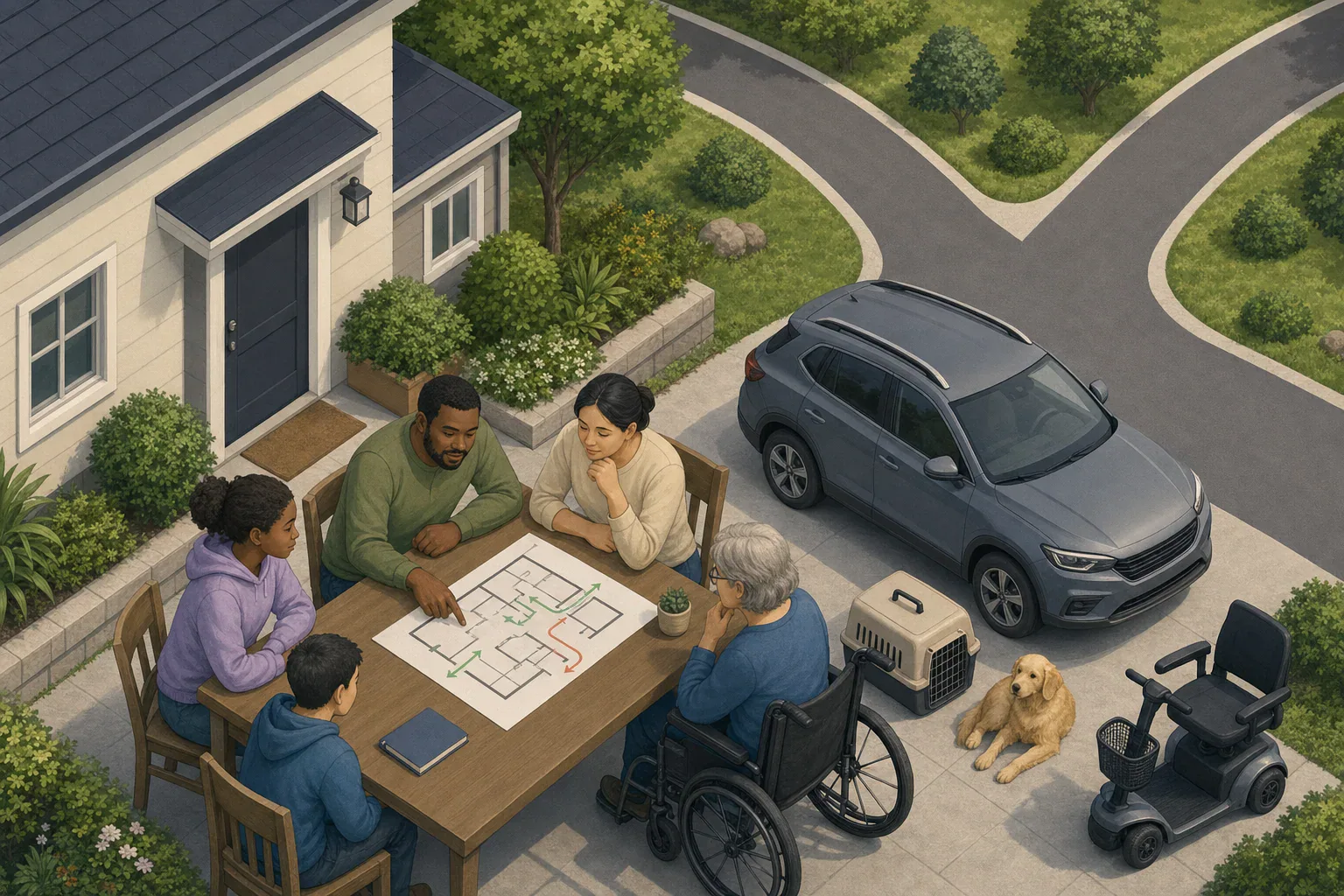
Quick answer: Use this evacuation plan template to record a primary and backup destination, two possible routes, transportation, conditional household roles, contacts, pet and accessibility needs, and copy locations. Complete it together, keep copies accessible, and follow current local evacuation instructions whenever conditions or official directions change.
One-page evacuation plan template
Copy or print this form and complete it with everyone in the household. During an emergency, current instructions from local authorities, road barriers, and responders take priority over anything written in the plan. Alert and evacuation terms can vary by jurisdiction; the National Weather Service emergency-message guidance says an “Evacuation Immediate” message may recommend or order evacuation under state law or local ordinance.
HOUSEHOLD EVACUATION PLAN

PLAN
Household name: ______________________________
Home address: ________________________________
Last reviewed: __________  Next practice: __________

OFFICIAL INFORMATION
Local emergency management URL/phone: __________________
Evacuation zone, if applicable: _________________________
Alert sources enrolled or monitored: ____________________

DESTINATIONS
Primary destination: ___________________________________
Full address: __________________________________________
Host or official contact: ______________________________
Confirmed available? ___________________________________

Backup destination: ____________________________________
Full address: __________________________________________
Host or official contact: ______________________________
Confirmed available? ___________________________________

MEETING PLACES
Near home: _____________________________________________
Outside neighborhood: __________________________________
Out-of-town location: __________________________________

ROUTES FROM HOME
Primary route, if officials allow it: ___________________
________________________________________________________
Alternate route, if officials allow it: _________________
________________________________________________________
Official route source or map: ___________________________
Rule: Current official directions override both routes.

TRANSPORTATION
Primary vehicle or method: ______________________________
Primary driver/operator: __________  Backup: ____________
Accessible transportation or equipment needed: __________
Confirmed backup transportation and contact: ____________

CONTACTS AND CHECK-IN
Out-of-area contact: ____________________________________
Phone/email: ____________________________________________
Household group message or other method: _________________
When to check in: _______________________________________
If calls fail, try: _____________________________________

ROLES — NAME A PRIMARY AND BACKUP
Children or dependents: Primary ______  Backup __________
Pets and pet supplies: Primary ________  Backup __________
Accessibility or medical support: Primary ____ Backup ____
Essential documents/contact sheet: Primary ___ Backup ____
Other essential household item: Primary ______ Backup ____

IF PEOPLE ARE APART
Child pickup/release rule: ______________________________
If someone is at home: __________________________________
If adults are at work: __________________________________
If someone is at school or a care location: ______________
If the primary driver is unavailable: ____________________
Everyone reports status to: _____________________________

COPIES
Full plan stored at: ____________________________________
Contact cards stored in: ________________________________
Digital copy stored at: _________________________________
Copy held by trusted contact: ___________________________
Limit sensitive medical and personal details to what household members genuinely need. A wallet card can hold only destinations and contact numbers, while a protected full copy can hold additional information.
Choose destinations and backup routes for your evacuation plan
- Name a primary and backup destination. A destination may be a confirmed host or an official shelter that is currently announced as open. Choose a backup the household could realistically use if the first option is unavailable.
- Record complete details. Add the full address, contact information, and any access, pet, or transportation arrangements that need confirmation. Do not assume a shelter is open, accessible, or able to accept pets.
- Identify two possible ways out. When practical, note distinct roads or transportation options. The U.S. Fire Administration’s wildfire evacuation guidance recommends planning primary and alternate routes, including from places household members regularly visit.
- Write down the official source. Add your city, county, tribal, or state emergency-management page, alert service, evacuation-zone map, or public-information number.
A navigation app can help with orientation, but it does not replace an evacuation order, designated route, traffic-control point, or responder direction. Hazards, closures, and traffic controls can make either planned route unusable.
How roles change when household members are apart
Roles should be conditional rather than assuming everyone starts at home. Give every critical task a backup, and account for school release rules, workplace plans, care locations, and accessible transportation.
| Starting situation | Planned action | Backup condition |
|---|---|---|
| Everyone is home | Use the primary assignments for dependents, pets, transportation, and the contact sheet. | Transfer a task if its assigned person is absent or cannot do it safely. |
| A child is at school or care | The authorized pickup person follows the facility’s emergency and release procedures. | A named, authorized backup takes over; others do not independently attempt pickup. |
| Adults are at work | Each person follows workplace instructions, reports status, and goes to the agreed meeting place when permitted. | The available backup handles home-based duties only if authorities say it is safe. |
| A person needs accessible transportation | Use the planned accessible vehicle, paratransit, or another confirmed option. | Contact the prearranged backup and report the delay to the household contact. |
| The primary driver or vehicle is unavailable | Use the named backup driver or transportation method. | Tell the out-of-area contact which destination or meeting place is now being used. |
The FEMA family communication planning document advises households to discuss how each person would reach meeting places and to account for transportation options such as public transportation, rail, and paratransit.
Household completion checklist
- Confirm the primary and backup destinations rather than listing unverified locations.
- Write full addresses and contact details.
- Record the local alert source, evacuation zone, and emergency-management page.
- Mark two possible routes, noting that official directions override them.
- Plan primary and backup transportation, including accessibility needs.
- Assign a primary person and backup for every essential responsibility.
- Write separate instructions for home, work, school, and care-location starts.
- Choose an out-of-area contact and a simple check-in method.
- Confirm school, care-facility, workplace, and pet arrangements.
- Place current copies where household members can reach them.
- Add a review date and a practice date.
Hypothetical completed example
This example is fictional. Its people, addresses, roads, and phone numbers are placeholders, not official route or destination recommendations.
- Primary destination: Confirmed host at 100 Example Lane, Neighboring County; contact Taylor at 555-0101.
- Backup destination: A county shelter listed through local emergency management, but only after confirming that it is open and meets the household’s access and pet needs.
- Routes: Primary—Example Road west to County Route A. Alternate—Sample Avenue south to County Route B. Current official directions override both.
- Transportation: An accessible household van, driven by Devin; Casey is the backup driver. A previously confirmed accessible transportation provider is the second option.
- People and pet roles: Casey is the authorized primary pickup person for Maya; Devin is the authorized backup. The person who is home takes the cat and carrier if doing so is consistent with official instructions. Casey assists Jo with mobility equipment when together; Devin is the backup.
- If apart: Maya remains under the school’s emergency procedures until released to an authorized adult. Jo follows workplace instructions and uses the confirmed accessible transportation backup if the household van cannot reach the workplace. Everyone reports status to the out-of-area contact.
- Copies: Full copies are kept in the household plan folder and go-kit. Short contact cards are in wallets and backpacks. A protected digital copy is available to both adults, and the out-of-area contact has the current destination list.
When to review and practice the plan
Review the plan at least once a year and whenever an address, phone number, school, workplace, care arrangement, transportation option, pet arrangement, or access need changes. FEMA’s family communication planning guidance recommends reviewing, updating, and practicing the communication plan at least annually or whenever information changes.
The American Red Cross recommends practicing evacuation twice a year. Practice can mean checking contact information, talking through different starting locations, confirming backup transportation, and following a planned route under normal conditions. Do not enter restricted areas or practice during hazardous conditions.
After each review or practice, update every copy. The document is a starting plan, not a guarantee that a destination, shelter, road, or transportation service will be available during an actual emergency.
Frequently asked question
Should we follow our written evacuation route if an app suggests a faster road?
No. Follow current instructions from local authorities, responders, road signs, and traffic-control points. Your written routes and an app can help with planning, but they do not override official evacuation directions or closures.
- Simple checklists and realistic planning
- Water, power, lighting, and pantry basics
- Family plans (kids, pets, seniors) and seasonal prep
Affiliate disclosure
As an Amazon Associate, we earn from qualifying purchases. Some links on this site may be affiliate links. If you buy through these links, we may earn a small commission at no extra cost to you. This helps support our content. Learn more.