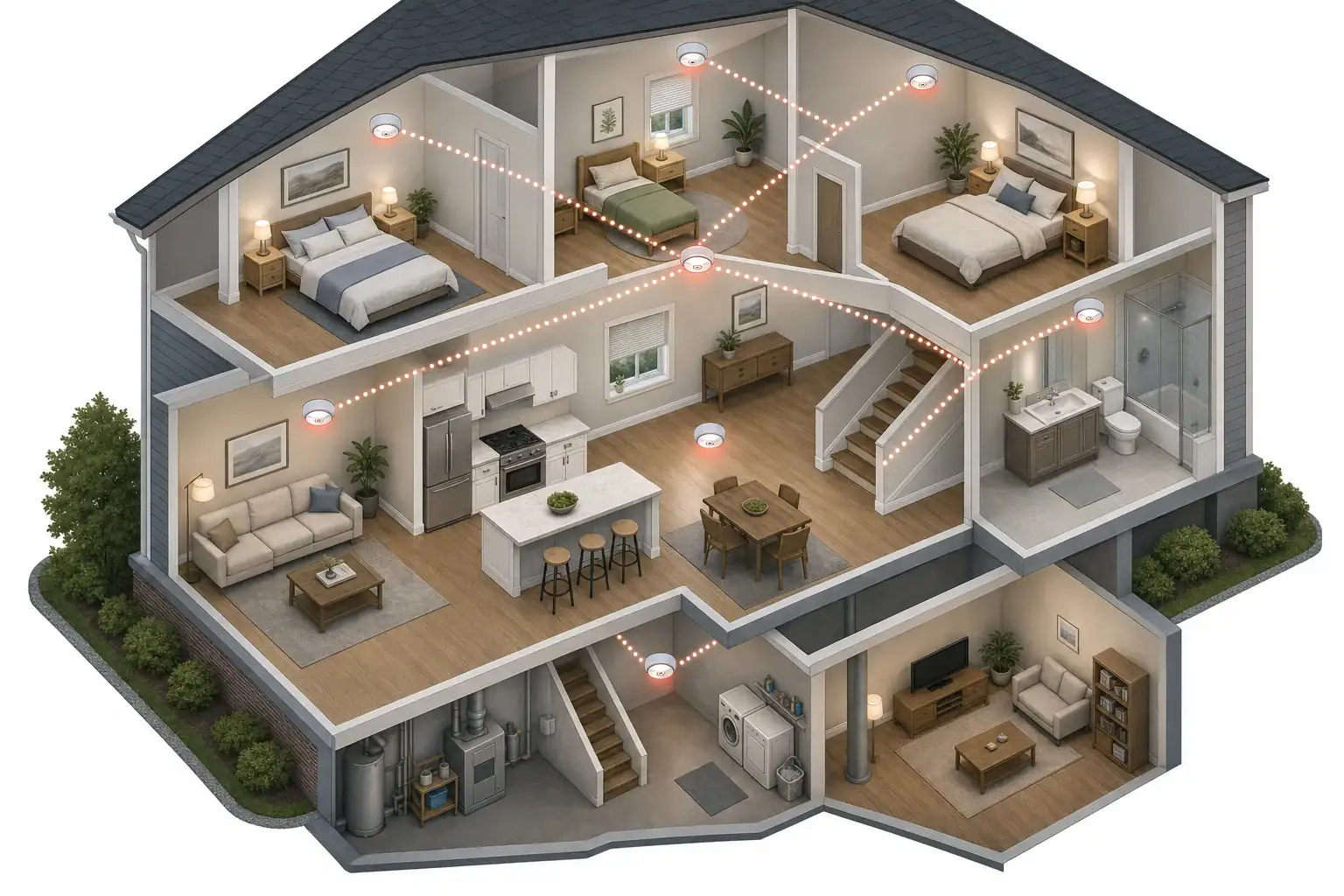
Quick answer: Choose listed residential smoke alarms that collectively provide photoelectric and ionization detection capabilities, can alert everyone in the household, and fit the home’s power and interconnection system. Near kitchens or bathrooms, consider photoelectric or appropriately labeled multi-criteria designs, then verify the exact model’s manual, compatibility documents, replacement guidance, and local requirements.
How to choose residential smoke alarms
Start with the household and the home rather than a product ranking. A practical plan for residential smoke alarms accounts for detection capabilities across the home, alerts that every resident can perceive, and the power and interconnection system already in place.
- Make a room-and-system inventory. List bedrooms, sleeping-area hallways, levels, the basement, and any locations your local authority requires. Record existing alarm model numbers, power sources, connectors, and interconnection method.
- Choose the sensing approach. Plan for photoelectric and ionization detection capabilities, either through separate listed alarms or a suitable dual-sensor model.
- Plan the alert system. Consider interconnection and any visual, tactile, or specialized audible alerts needed for residents, especially while sleeping.
- Check exact models before buying. Confirm listing, approved interconnect combinations, installation restrictions, replacement information, and the manufacturer’s instructions.
- Confirm local rules. State and local requirements may be more specific than national guidance.
The U.S. Fire Administration’s smoke alarm guidance discusses sensor types, power options, interconnection, accessibility, and replacement. For requirements that apply to a particular property, ask the local fire marshal or building authority.
Compare smoke-sensing technologies
Photoelectric alarms
Photoelectric alarms tend to respond faster to smoke from smoldering fires. The National Fire Protection Association (NFPA) identifies photoelectric alarms as preferable near kitchens and bathrooms to help reduce nuisance alarms. This is a buying consideration, not permission to install an alarm wherever convenient: follow the exact model’s location restrictions.
Ionization alarms
Ionization alarms tend to respond faster to smoke from flaming fires. Because fires vary, this tendency does not make ionization technology universally better or worse than photoelectric technology. USFA recommends having both technologies or a dual-sensor alarm.
Dual-sensor and multi-criteria designs
A dual-sensor smoke alarm includes photoelectric and ionization sensing in one unit. Another approach is using separate listed alarms so both detection capabilities are represented across the home.
Multi-criteria models may use more than one input to evaluate conditions and may be marketed as helping reduce cooking nuisance alarms. Do not assume that an advanced-sounding feature means a unit has both photoelectric and ionization sensing. Read the package, listing information, and manual for the exact model.
Choose power, interconnection, and accessible alerts
Power source
- Replaceable-battery alarms: Use only the battery type and replacement schedule stated in the manual.
- Sealed long-life-battery alarms: Replace the complete unit according to its instructions. A long-life battery does not guarantee the same service period in every situation.
- Hardwired alarms: Check the model’s backup-power requirements and local electrical rules. Have hardwired installation or circuit changes performed by a qualified electrician.
Interconnection
When compatible alarms are interconnected, activation of one causes the connected alarms to sound. This can be especially useful for remote levels, basements, and sleeping areas where one distant alarm may be difficult to hear.
Compatibility is model-specific. Do not assume alarms work together because they share a brand, connector shape, wireless feature, or adapter. Compare exact model numbers with the manufacturer’s approved interconnect documentation. For an existing hardwired location, also verify the connector, circuit, backup-power requirement, and whether any adapter is permitted by the manufacturer.
Alerts residents can perceive
People who are deaf or hard of hearing may need listed strobes, bed or pillow shakers, or appropriate audible alert devices. The right arrangement depends on the resident’s needs, including while asleep. NFPA’s smoke alarm guidance for people with disabilities describes these options and advises using equipment bearing a recognized testing-laboratory label.
Phone notifications may be a useful supplementary feature. Before relying on one, check which events it transmits and what happens during a power, internet, or service outage. A phone notification is not a substitute for the alarm’s on-site audible, visual, or tactile alert.
Dual-sensor versus smoke/CO combination units
These terms describe different features:
- Dual-sensor smoke alarm: Uses two smoke-detection technologies, generally photoelectric and ionization.
- Smoke and carbon monoxide combination alarm: Detects two hazards. Its smoke function may use one sensing technology or more than one.
A smoke/CO combination unit can consolidate devices where both types of protection are appropriate. It does not automatically satisfy every smoke-alarm and carbon-monoxide-alarm requirement. Verify its listing, alert patterns, instructions for both functions, replacement guidance, and local rules. Do not move a smoke alarm to an unsuitable location merely to gain carbon monoxide coverage.
Room-by-room buying decisions
| Location or situation | Primary buying decision |
|---|---|
| Bedrooms and sleeping areas | Provide both smoke-detection capabilities across the home; consider interconnection and accessible alerts where needed. |
| Hall outside sleeping rooms | Confirm that the chosen alarm can be part of a compatible interconnected system and provides an alert residents can perceive while asleep. |
| Near a kitchen or bathroom | Consider photoelectric or appropriately labeled multi-criteria technology, subject to the model manual’s location restrictions. |
| Basement or remote level | Consider an approved interconnected model so an activation is reported elsewhere in the home. |
| Existing hardwired position | Verify approved models, connector or permitted adapter, circuit requirements, backup power, and local electrical rules. |
| Area needing smoke and CO coverage | A combination unit may consolidate devices, but verify instructions and local rules for both hazards. |
| Resident who may not hear a standard alarm | Plan a compatible listed system with suitable visual, tactile, or specialized audible alerts. |
What to verify on labels, dates, and manuals
Before committing to an exact model, verify the following:
- Listing: Look for the mark of a nationally recognized testing laboratory and confirm it covers the functions being purchased. The Consumer Product Safety Commission identifies standards and model codes associated with residential smoke alarms, but the edition adopted locally varies.
- Model identity: Match the package, alarm, manual, and compatibility documentation by exact model number.
- Manufacture and replacement information: USFA says smoke alarms generally should be replaced 10 years from the manufacture date. Follow the unit’s instructions when they specify a different trigger, such as activation or installation, or call for earlier replacement after a fault or end-of-life signal.
- Interconnect limits: Confirm approved alarm and accessory models, maximum system limits, wiring or wireless requirements, and the alerts supported by the system.
- Installation restrictions: Read the manual for permitted locations, mounting, environmental limits, and testing instructions.
- Local requirements: Ask the local fire marshal or building authority about required locations, power sources, sealed batteries, hardwiring, permits, and rules that may apply to rental or remodeled properties.
Blank household alarm-count checklist
- Bedrooms: ___ rooms × ___ alarms = ___
- Separate sleeping areas or hallways: ___
- Main level: ___
- Upper levels: ___
- Basement: ___
- Other locally required locations: ___
- Accessible-alert devices or accessories: ___
- Smoke/CO combination locations: ___
- Total planned units: ___
- Existing brand and model numbers recorded: Yes / No
- Power source and connectors recorded: Yes / No
- Manufacture and replacement dates checked: Yes / No
- Interconnect compatibility verified in manuals: Yes / No
- Local fire or building authority checked: Yes / No
Frequently asked questions
Is a dual-sensor smoke alarm the same as a smoke/CO combination alarm?
No. A dual-sensor smoke alarm describes the smoke-sensing technologies in the unit, typically photoelectric and ionization. A smoke/CO combination alarm detects both smoke and carbon monoxide. A combination unit may or may not include more than one smoke-sensing technology, so check its documentation.
Can I replace one hardwired alarm with any model that fits the connector?
No. The physical connector alone does not establish compatibility. Check the manufacturer’s approved model list, wiring instructions, backup-power requirements, and local electrical requirements before replacing a hardwired alarm.
- Simple checklists and realistic planning
- Water, power, lighting, and pantry basics
- Family plans (kids, pets, seniors) and seasonal prep
Affiliate disclosure
As an Amazon Associate, we earn from qualifying purchases. Some links on this site may be affiliate links. If you buy through these links, we may earn a small commission at no extra cost to you. This helps support our content. Learn more.