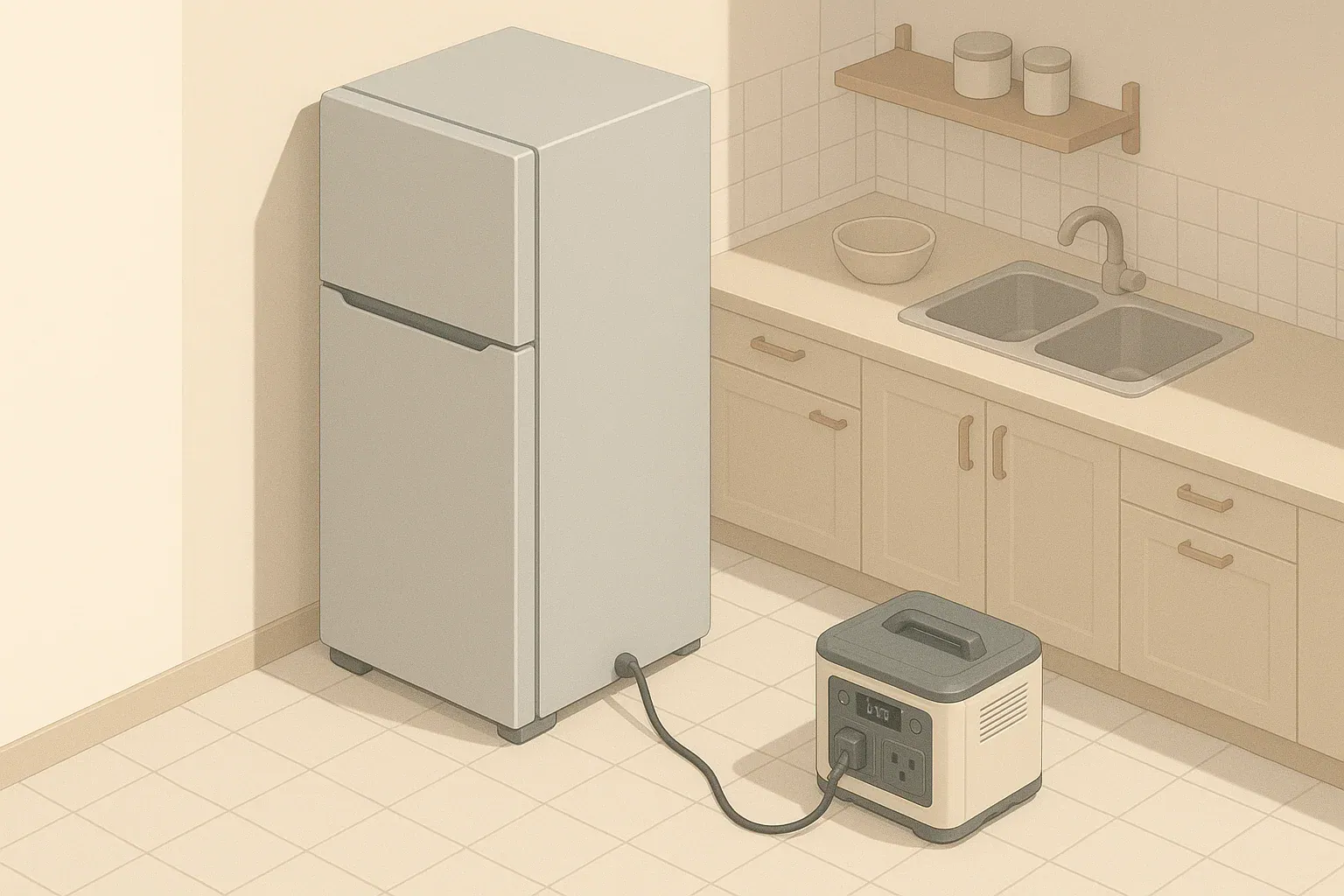
How much backup power does a refrigerator need?
Most full-size home refrigerators use about 100–800 watts while running, but they do not run constantly. Over a full day, many households see roughly 1–2 kilowatt-hours (kWh) of energy use from a typical refrigerator.
For short outages, a practical rule of thumb is:
- Minimum running power: a backup source that can provide at least 600–800 watts of continuous power for one standard refrigerator.
- Startup surge: brief surges can be 2–3 times the running watts. Aim for a backup source that can handle 1,200–2,400 watts of surge for a full-size unit.
- Energy for 24 hours: plan for about 1–2 kWh per day per refrigerator, assuming you keep the doors closed as much as possible.
Those numbers are only estimates. Your actual needs depend on the size, age, and efficiency of your fridge, and how you use it during an outage. The steps below help you get a more accurate answer for your home.
Step 1: Find your refrigerator’s wattage
Start by checking what your specific refrigerator needs instead of relying only on averages.
Check the label or manual
Look for a data label, usually:
- Inside the fridge compartment (side wall or near the crisper)
- On the back of the unit
- On the door frame
The label may list:
- Watts (W) – easiest to use directly.
- Amps (A) and volts (V) – you can calculate watts as W = A × V.
Example: If the label says 3.5 A at 120 V, then 3.5 × 120 ≈ 420 watts while the compressor is running.
If you only see annual kWh
EnergyGuide labels often show estimated yearly energy use, like “400 kWh per year.” That tells you average energy use, not the exact running watts, but it still helps:
- Divide the yearly number by 365 to get a rough daily use. Example: 400 ÷ 365 ≈ 1.1 kWh per day.
- Use that daily number later when you size your battery or fuel.
Using a plug-in power meter (optional)
If you want better data and can safely access the outlet, a simple plug-in power meter can show:
- Running watts when the compressor is on
- Total kWh over 24 hours of normal use
This is one of the most accurate ways to size backup power, but only if you can do it safely and without overloading the outlet or using unsafe extension cords.
Step 2: Account for startup surge
Refrigerators need extra power for a split second when the compressor starts. This is called surge or starting watts.
As a simple rule:
- Estimate surge as 2–3 times the running watts.
- If your fridge runs at 400 W, plan for at least 800–1,200 W of surge capacity.
When you choose a backup source (generator, battery, or power station), make sure its surge or peak rating is higher than your estimated startup surge. If the surge rating is too low, the fridge may fail to start or the backup device may shut down.
Step 3: Estimate how long you want to run it
Next, decide how many hours of backup you want. This is about energy (watt-hours or kilowatt-hours), not just watts.
Typical energy use
For planning, many modern full-size refrigerators fall roughly in these ranges under normal use:
- Small top-freezer or apartment fridge: about 0.7–1.2 kWh per day
- Standard full-size fridge-freezer: about 1–2 kWh per day
- Large side-by-side or French door: about 1.5–2.5+ kWh per day
During an outage, you can usually cut energy use somewhat by:
- Keeping doors closed as much as possible
- Turning off ice makers and extra features
- Not adding warm food or drinks
How much energy for your goal?
Use this simple approach:
- Estimate your fridge’s daily energy use (for example, 1.2 kWh per day).
- Multiply by the number of days you want to cover.
- Add a buffer of 20–30% for safety.
Example: You want to run a fridge that uses about 1.2 kWh per day for 24 hours.
- 1.2 kWh × 1 day = 1.2 kWh
- Add 30% buffer: 1.2 × 1.3 ≈ 1.6 kWh
- So you would look for roughly 1.6 kWh of usable backup energy.
Remember that some battery systems and power stations list total capacity, but not all of that is usable. Check the manufacturer’s guidance and, if in doubt, assume you can use only part of the stated capacity.
Choosing a type of backup power
Once you know your approximate running watts, surge watts, and desired hours of runtime, you can compare backup options. Always follow manufacturer instructions and any local codes. For safety guidance on generators and fuel, see the U.S. Consumer Product Safety Commission’s portable generator safety information.
Portable power stations and batteries
These are plug-in battery units with built-in inverters and outlets.
Pros:
- No exhaust, can be used indoors as directed
- Quiet and low-maintenance
- Often show real-time watts and remaining runtime
Cons:
- Limited runtime unless you have solar or a way to recharge
- Higher cost per kWh than fuel-based options
Match the power station’s ratings to your fridge:
- Continuous output: at least 600–800 W for one standard fridge
- Surge output: at least 1,200–2,400 W, or whatever your fridge requires
- Capacity: for example, a 1,000 Wh (1 kWh) unit might run a fridge that averages 100 W for around 8–9 hours, but less if the fridge works harder in a warm room
Portable generators
Portable generators can power a refrigerator and other loads, but they come with important safety risks. Incorrect use can cause carbon monoxide poisoning, fire, or electric shock. The Centers for Disease Control and Prevention generator safety guidance and Ready.gov power outage tips explain key precautions.
For a fridge, look at:
- Running watts: enough for the fridge plus any other devices you plan to power at the same time
- Surge watts: enough to handle the fridge starting plus any other loads starting up
- Fuel use: how many hours at a given load per tank, and how much fuel you can safely store according to local rules
Safety basics for generators:
- Operate them outdoors only, far from doors, windows, and vents, to avoid carbon monoxide buildup.
- Use heavy-duty outdoor-rated cords if plugging in directly, and avoid overloading them.
- Never plug a generator into a wall outlet or home wiring without a properly installed transfer switch from a qualified electrician.
- Install and maintain carbon monoxide alarms as recommended by the National Fire Protection Association carbon monoxide safety guidance.
Whole-house or standby systems
Standby generators and home battery systems can power a refrigerator along with much of the home. Sizing these systems is more complex and usually involves a licensed electrician or installer.
For the refrigerator portion, you still use the same numbers: running watts, surge watts, and daily kWh. A professional can then combine that with the rest of your home’s loads and local electrical codes.
Practical ways to stretch your backup power
Even a modest backup setup goes further if you help the refrigerator work less.
- Pre-chill before storms: If you have warning, lower the fridge and freezer temperature slightly within safe food ranges before an expected outage.
- Keep doors closed: Plan what you need before opening the door, and close it quickly.
- Group cold items: Keeping items close together helps them stay cold longer.
- Use the freezer as a cold bank: A full freezer stays cold longer. If you have empty space, you can freeze containers of water ahead of time for extra thermal mass.
- Turn off nonessential features: Ice makers, door displays, and extra lights all add a little load.
For food safety, the U.S. Department of Agriculture’s guidance on keeping food safe during an emergency explains how long food stays safe in a refrigerator or freezer without power and when to throw items away.
Simple planning checklist
To plan backup power for your refrigerator:
- Find your fridge’s running watts from the label or a meter.
- Estimate surge watts (2–3× running watts).
- Estimate daily energy use (kWh per day) from the label or a meter.
- Decide how many hours or days you want to cover.
- Choose a backup source (battery, power station, generator, or standby system) that meets both the power (watts) and energy (kWh or fuel) needs, with a safety margin.
- Review safety guidance for generators, cords, and carbon monoxide alarms, and follow local codes and manufacturer instructions.
If you are unsure about electrical loads, wiring, or transfer switches, it is safer to consult a licensed electrician or qualified installer rather than guessing.
Frequently asked questions
Can a small portable power station run a refrigerator?
Sometimes. A small unit may have enough watts to start and run an efficient refrigerator for a few hours, but many compact models do not have enough surge power or battery capacity for long outages. Compare your fridge’s running and surge watts to the power station’s continuous and peak ratings, and check its watt-hour capacity to estimate runtime.
How long will a refrigerator stay cold without any power?
According to the U.S. Department of Agriculture, a refrigerator can usually keep food cold for about 4 hours if the door stays closed, and a full freezer can hold a safe temperature for about 48 hours (24 hours if half full). Actual times vary with room temperature, how often you open the door, and how full the appliance is.
Should I run my refrigerator continuously during an outage?
If backup power is limited, some people cycle the fridge on and off to save energy. This can work, but it increases the risk of food warming into an unsafe range. If you try this, keep doors closed, monitor how cold the fridge stays, and follow official food safety guidance. When in doubt, keeping the fridge powered and discarding questionable food is safer than pushing the limits.
Can I plug my refrigerator into a generator with an extension cord?
Yes, but only if you use a heavy-duty, outdoor-rated extension cord that is properly sized for the load and length, and you follow the generator manufacturer’s instructions. The generator must stay outdoors, far from doors and windows, to prevent carbon monoxide buildup. Never plug a generator into a wall outlet or home wiring without a properly installed transfer switch from a qualified electrician.
- Simple checklists and realistic planning
- Water, power, lighting, and pantry basics
- Family plans (kids, pets, seniors) and seasonal prep
Affiliate disclosure
As an Amazon Associate, we earn from qualifying purchases. Some links on this site may be affiliate links. If you buy through these links, we may earn a small commission at no extra cost to you. This helps support our content. Learn more.